Sensitivity-Aware Mixed-Precision Quantization for ReRAM-based Computing-in-Memory
By Guan-Cheng Chen 1, Chieh-Lin Tsai 2, Pei-Hsuan Tsai 1, Yuan-Hao Chang 2
1 National Cheng Kung University, Tainan, Taiwan
2 National Taiwan University, Taipei, Taiwan
Abstract
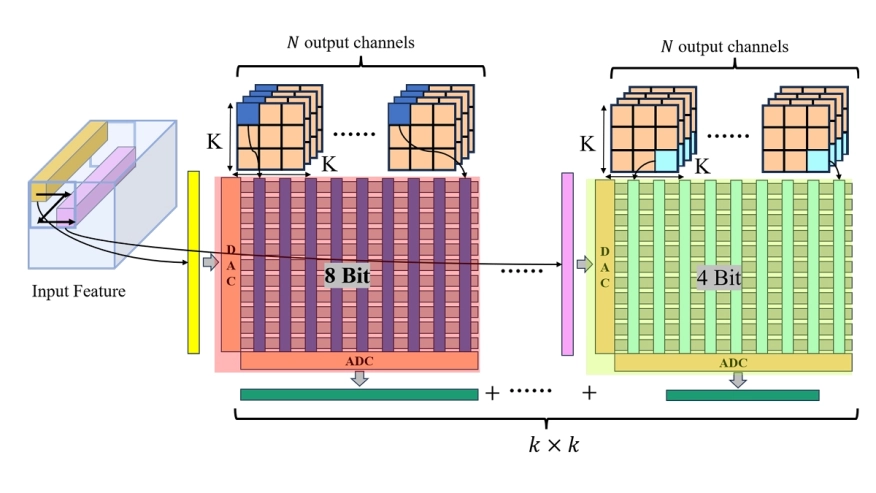
Compute-In-Memory (CIM) systems, particularly those utilizing ReRAM and memristive technologies, offer a promising path toward energy-efficient neural network computation. However, conventional quantization and compression techniques often fail to fully optimize performance and efficiency in these architectures. In this work, we present a structured quantization method that combines sensitivity analysis with mixed-precision strategies to enhance weight storage and computational performance on ReRAM-based CIM systems. Our approach improves ReRAM Crossbar utilization, significantly reducing power consumption, latency, and computational load, while maintaining high accuracy. Experimental results show 86.33% accuracy at 70% compression, alongside a 40% reduction in power consumption, demonstrating the method's effectiveness for power-constrained applications.
To read the full article, click here
Related Semiconductor IP
- nQrux® Root of Trust IP
- AXI to UCIe Bridge IP
- UCIe 2.x Controller IP
- SWI3S (SoundWire I3S Interface) Peripheral Controller Core IP
- OpenTitan-based RISC-V Secure Element
Related Articles
- VitaLLM: A Versatile and Tiny Accelerator for Mixed-Precision LLM Inference on Edge Devices
- Pyramid Vector Quantization and Bit Level Sparsity in Weights for Efficient Neural Networks Inference
- LLM Inference with Codebook-based Q4X Quantization using the Llama.cpp Framework on RISC-V Vector CPUs
- SPAD: Specialized Prefill and Decode Hardware for Disaggregated LLM Inference
Latest Articles
- Automated Pre-Silicon Verification of High-Speed DDR5 and LPDDR5/6 Memory Controllers: Closed-Loop Timing, Mode Register, and PHY Synchronization in UVM
- U-Sonic: An Open-Source 8-Channel Ultrasound Transmit IP in a 130 nm RISC-V SoC
- S-ALSA: Co-Design of Adiabatic Logic-based Sensing and Balanced Bit-Cells for Secure and Energy-Efficient MRAM
- MEGATRON: a 28nm Analog PCM CiM/Digital System-on-Chip for Edge GenAI at 57.5 TOPS/W and 1.52 Mparam/mm²
- Peregrino: A Full-Hardware Accelerator for the Complete Falcon Post-Quantum Digital Signature Scheme on Resource-Constrained Edge Devices