S-ALSA: Co-Design of Adiabatic Logic-based Sensing and Balanced Bit-Cells for Secure and Energy-Efficient MRAM
By Wu Yang 1 , Amit Degada 2, Himanshu Thapliyal 1
1 Southern Methodist University, Dallas, SA
2 University of Tennessee, Knoxville, USA
Abstract
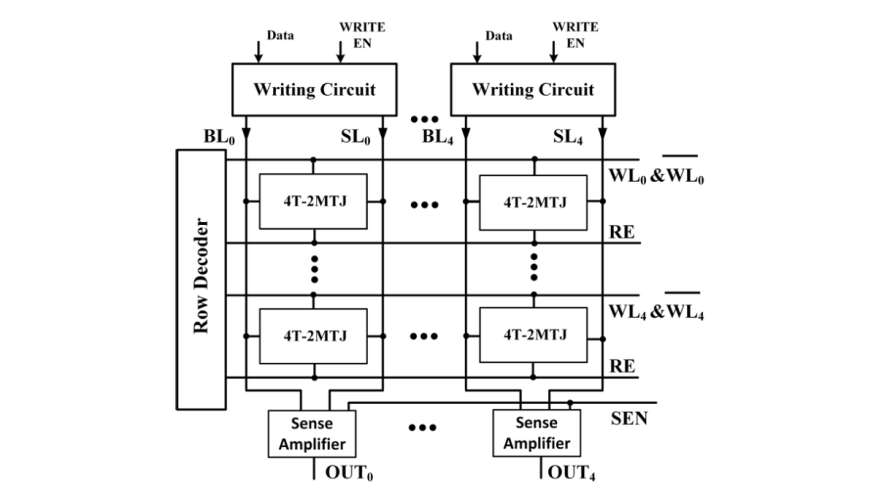
Magnetoresistive Random Access Memory (MRAM) technologies such as Spin-Transfer Torque (STT-MRAM) and Spin-Orbit Torque assisted (SOT-STT-MRAM) offer nonvolatility and low leakage, making them attractive for IoT systems. However, conventional MRAM read circuits face two fundamental challenges: high dynamic energy consumption and vulnerability to side-channel attacks caused by data-dependent current variations in Magnetic Tunnel Junctions (MTJs). This paper presents a Secured Adiabatic Logic Sense Amplifier (SALSA) that addresses both challenges simultaneously through circuit-device co-design. S-ALSA combines structural current balancing via a 4T-2MTJ bit cell, which eliminates read current asymmetry at the storage level, with dynamic power equalization via adiabatic charge recovery in the sensing circuit. The proposed architecture supports both STT-MRAM and SOT-STT-MRAM. Case studies using 4x4 MRAM macros shows up to 80% energy savings over conventional Pre-Charge Sense Amplifiers (PCSA) across IoT frequencies. Correlation Power Analysis (CPA) attacks on PRESENT-80 encryption confirm complete suppression of key leakage when S-ALSA is combined with a balanced bit cell. This work establishes a unified framework where energy efficiency and hardware security are achieved simultaneously, enabling secure and low-power IoT memory design.
Index Terms—Magnetic Tunnel Junction (MTJ), Hybrid CMOS/MTJ, STT-MRAM, SOT-MRAM, Reading Circuits, En ergy Saving, Side-Channel Attack
To read the full article, click here
Related Semiconductor IP
- MRAM Memory Model
- MRAM Synthesizable Transactor
- Low Power Memory IP
- AMBA SPI Controller MRAM Controller
- Power and Clock Generation IP - GLOBALFOUNDRIES® 22FDX®
Related Articles
- Embedded Systems: Programmable Logic -> Programming enters designer's core
- Embedded Systems: Programmable Logic -> Common gateway networks enable remote programs
- Embedded Systems: Programmable Logic -> FPGAs don remote reprogram habits
- Embedded Systems: Programmable Logic -> Embarrassment of riches hinders proper use of Moore's Law
Latest Articles
- A 105 MS/s 4.18 nJ/inference 0.765 mm² Mixed-Signal Streaming ML Engine for Wireless Baseband in 12LP+ FinFET
- Agentic AI for Heterogeneous System Design Across Chip, Scale-Up, and Scale-Out Domains
- Minimum RISC-V: Maximum FPGA Efficiency
- The Era of Vibe Tapeout: Dark Age or Golden Age for Analog Circuit Design?
- Understanding the Power Consumption of Modern High Bandwidth Memory: Experimental Analysis and Modeling Using Real HBM2 DRAM Chips