A Secure dToF LiDAR SoC with Dual-Domain Fingerprinting and Event-Driven AFE Circuit Achieving Sensor-Level Attack Resilience
By Risa Nonaka, Ryoya Matsuno, Shota Nagai, Satomi Miyagi, Yuki Hayakawa, Ryo Suzuki, Kazuma Ikeda, Ozora Sako, Rokuto Nagata, Ryo Yoshida, Shimpei Ando, Wenlun Zhang, Kentaro Yoshioka
Keio University, Japan
Abstract
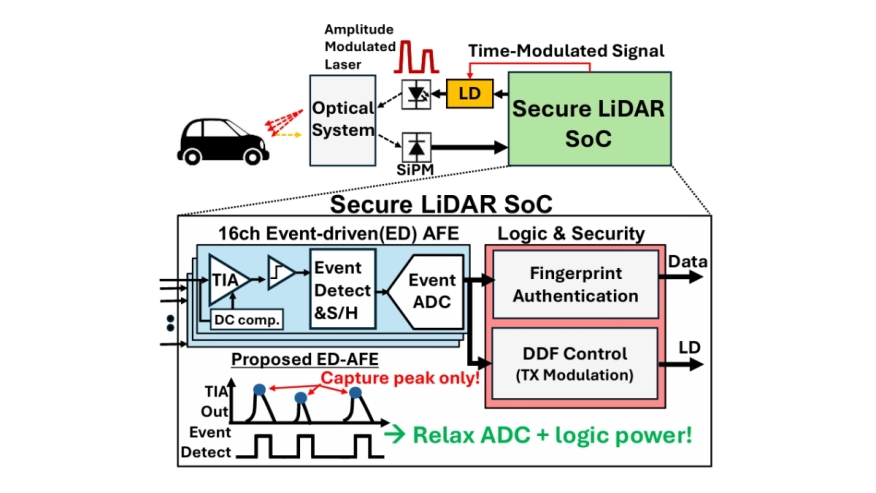
Recent studies have shown that most commercial direct time-of-flight (dToF) LiDARs can be spoofed by injecting high-frequency laser pulses into the receiver, which can erase pedestrians from the point cloud. This paper presents the first dToF LiDAR system-on-chip (SoC) with integrated sensor-level hardware security against spoofing attacks. We propose Dual-Domain Fingerprinting (DDF), which emits laser pulse pairs whose time interval and amplitude ratio are both randomized and authenticates received echoes in this two-dimensional space, so that spoofed signals are rejected before they corrupt the ranging result. An Event-Driven AFE (ED-AFE) activates the ADC only around pulse peaks: it digitizes three samples around each peak with a triggered ADC at 1-GHz sampling and applies parabolic interpolation, achieving 1-cm distance resolution with a 99% reduction in ADC power. A time-modulated laser driver controls the laser amplitude from 10% to 100% by modulating the charge time of a laser capacitor, providing the microsecond-order amplitude modulation required by DDF. A LiDAR system with a 16-channel 65-nm CMOS prototype SoC demonstrates up to 120-m ranging and an AFE power of 3.1 mW per channel, 60% lower than prior art. In a proof-of-concept experiment in which the dual-domain authentication is applied to measured sensor data, 73% of the point cloud is protected under spoofing attack, compared with 0% without DDF.
To read the full article, click here
Related Semiconductor IP
- Vision 341 DSP
- Single 512-bit SIMD DSP for Vision/Radar/Lidar/AI
- ConnX 120 DSP
- Video Design Framework for Multi-camera Vision Applications
- Vision AI DSP
Related Articles
- Setting up secure VPN connections with cryptography offloaded to your Altera SoC FPGA
- Secure SOC for Security Aware Applications
- SPARX: Secure and Privacy-Aware Approximate CNN Acceleration with Edge RISC-V SoC
- How a voltage glitch attack could cripple your SoC or MCU - and how to securely protect it
Latest Articles
- Cryogenic Recharacterization of a Commercial 22 nm FD-SOI Foundry Standard-Cell Library
- A 105 MS/s 4.18 nJ/inference 0.765 mm² Mixed-Signal Streaming ML Engine for Wireless Baseband in 12LP+ FinFET
- Agentic AI for Heterogeneous System Design Across Chip, Scale-Up, and Scale-Out Domains
- Minimum RISC-V: Maximum FPGA Efficiency
- The Era of Vibe Tapeout: Dark Age or Golden Age for Analog Circuit Design?