Methods to Fine-Tune Power Consumption of PCIe devices
Philippe Legros, Romain Tourneau (PLDA)
Introduction
A basic paradox of electronic evolution is the desire to enable the execution of more functions while consuming less power and silicon area. For PCIe® applications, this goal is not a new one. A PCI power management specification has been available since 1997, and PCI Express® has featured native power management since its initial release in 2002. In addition, there has always been a recognized need for low power in the mobile market.
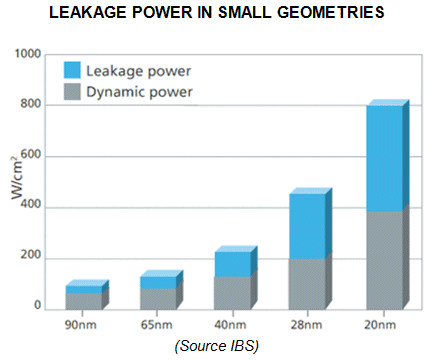
Historically, advances in ASIC technology have led to reductions in power, but this is no longer the case for the smallest geometries due to much higher leakage power. Leakage power—the power consumed by unintended leakage currents that do not contribute to the IC’s function, is a major problem that has been growing as process geometries shrink.
Drivers for Change
In addition to the mobile market, new markets such as datacenters, are increasingly concerned with power consumption numbers. According to Patrick Thibodeau of Computerworld, “U.S. data centers are using more electricity than they need. It takes 34 power plants, each capable of generating 500 megawatts of electricity, to power all the data centers in operation today”. The Internet of Things (IoT) and increased movement of all computer platforms to cloud computing has necessitated an increase in datacenter and server capacities. While ecological issues are always a concern, the cooling and power costs incurred for each additional MW of power consumed have become a real economic problem for business.
For these reasons, PCI Express designers are facing an ever-growing demand for lower consumption PCI Express devices. In order to optimize a PCIe design for low power, it is important to understand which power consumption figures are relevant for each type of application, and how they can be estimated.
Related Semiconductor IP
- PCIe Gen4 RX/TX IP Supporingt PCIe 1.0/2.0/3.0/4.0 up to 16Gbps. CTLE boosts up to 18dB at 8GHz
- PCIe Gen 6 Subsystem
- PCIe Gen 6 IP Core
- PCIe Controller IP
- Verification IP for PCIe
Related Articles
- Leverage always-on voice trigger IP to reach ultra-low power consumption in voice-controlled devices
- How Low Can You Go? Pushing the Limits of Transistors - Deep Low Voltage Enablement of Embedded Memories and Logic Libraries to Achieve Extreme Low Power
- Growing demand for high-speed data in consumer devices gives rise to new generation of low-end FPGAs
- Reducing Power Consumption of Embedded Dynamic Memories with ECCs
Latest Articles
- FlexSpIM: An Event-Based Digital Compute-In-Memory Accelerator with Flexible Operand Resolution and Layer-Wise Hybrid Stationarity
- MeshKV: A Network-on-Chip KV Cache Fabric for Scalable Transformer Decoding Accelerators
- Analog Pin Directionality as an Exfiltration Attack Surface in Mixed-Signal ICs
- SIMT-Aware Lockstep Verification and Functional-Coverage Closure Methodology for an Open-Source RISC-V GPGPU: A UVM 1.2 Environment
- Efficient Hardware Information-Flow Tracking for Pre-Silicon Security Testing