Versat-AI: An ONNX-to-SoC Compiler for Model-Agnostic CGRA Edge Inference
By Rúben Teixeira 1, João Barreiros Rodrigues 2, Jaime Aguiar 1,2, Jiao Li 3 and José T. de Sousa 1,2
1 IObundle, Lda, Lisbon, Portugal
2 INESC-ID; INESC INOV; Instituto Superior Técnico, Universidade de Lisboa, Lisbon, Portugal
3 Microelectronics Research Development Center, School of Mechatronic Engineering and Automation, Shanghai University, Shanghai, 200444, China
Abstract
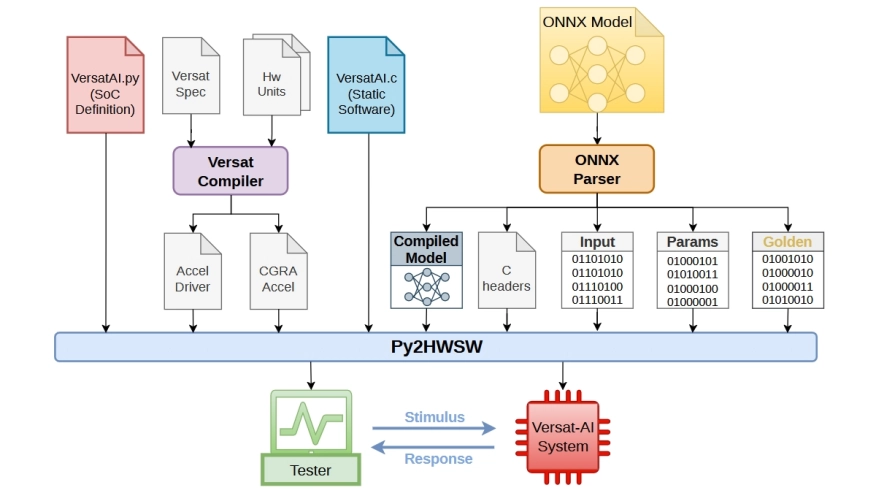
Edge inference on resource-constrained embedded nodes demands accelerators that are energy-efficient and compact. This paper presents Versat-AI, an open-source compiler that accepts a standard Open Neural Network Exchange (ONNX) model and generates a complete, synthesisable RISC-V System-on- Chip (SoC) with an embedded CGRA accelerator. The key innovation is applying a known hardware merge strategy to collapse structurally compatible neural network operators into a physical CGRA instance. The Versat-AI compiler also derives memory-mapped interconnects, firmware drivers, and RISC-V application software co-generated by the Py2HWSW SoC framework, eliminating the manual hardware/software co-design effort that previously tied this accelerator’s own design lineage to a single target network. The next phase of the project is to extend this same automatic derivation from sizing the operator vocabulary to sizing per-operator parallel instancing and bandwidth, following the bandwidth-matched scaling principle already demonstrated, by hand, in this accelerator’s own design lineage. The current phase of the project has succeeded in creating an sound automation flow that produces an accelerator that maps each operator onto a single physical datapath instance and occupies 8,763 LUTs, 9,833 flip-flops, 4 DSPs, and 202 BRAMs on a Xilinx Kintex Ultrascale field-programmable gate array (FPGA)—a footprint unchanged across all evaluated models regardless of size—and draws 0.65 W (1.96 W for the complete SoC including DDR4 controller), achieving 2.3× to 9× speedup over a software-only baseline on four MLPerf Tiny benchmark tasks. The paper also surveys the two-decade lineage of reconfigurable accelerators that motivated Versat-AI’s design, and documents the open- source SoC platform development—including two prior integration attempts and the decisions that led to IOb-SoC.
Keywords: edge inference; CGRA; ONNX; RISC-V SoC; FPGA; hardware accelerator; deep learning; hardware/software co-generation; neural network; open-source; low power; energy efficiency
To read the full article, click here
Related Semiconductor IP
- 24-bit/-140 dB THD+N Multi-Channel Audio Async Sample Rate Converter
- Audio I2S-TDM Transceiver
- RISC-V-based SoC template
Related Articles
- AI Edge Inference is Totally Different to Data Center
- The Expanding Markets for Edge AI Inference
- FPGA-Accelerated RISC-V ISA Extensions for Efficient Neural Network Inference on Edge Devices
- PermuteV: A Performant Side-channel-Resistant RISC-V Core Securing Edge AI Inference
Latest Articles
- Automated Pre-Silicon Verification of High-Speed DDR5 and LPDDR5/6 Memory Controllers: Closed-Loop Timing, Mode Register, and PHY Synchronization in UVM
- U-Sonic: An Open-Source 8-Channel Ultrasound Transmit IP in a 130 nm RISC-V SoC
- S-ALSA: Co-Design of Adiabatic Logic-based Sensing and Balanced Bit-Cells for Secure and Energy-Efficient MRAM
- MEGATRON: a 28nm Analog PCM CiM/Digital System-on-Chip for Edge GenAI at 57.5 TOPS/W and 1.52 Mparam/mm²
- Peregrino: A Full-Hardware Accelerator for the Complete Falcon Post-Quantum Digital Signature Scheme on Resource-Constrained Edge Devices