Leveraging FPGAs for Homomorphic Matrix-Vector Multiplication in Oblivious Message Retrieval
By Grant Bosworth 1, Keewoo Lee 2, and Sunwoong Kim 1
1 Rochester Institute of Technology, Rochester, NY, USA,
2 Ethereum Foundation
Abstract
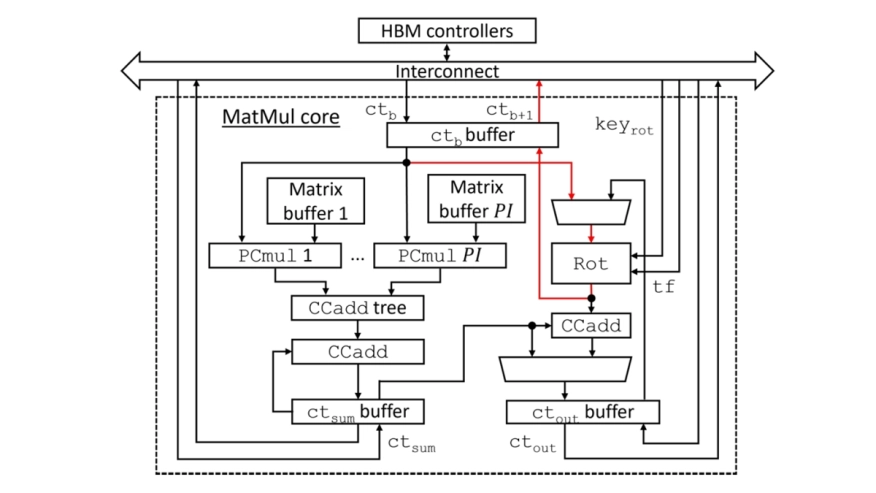
While end-to-end encryption protects the content of messages, it does not secure metadata, which exposes sender and receiver information through traffic analysis. A plausible approach to protecting this metadata is to have senders post encrypted messages on a public bulletin board and receivers scan it for relevant messages. Oblivious message retrieval (OMR) leverages homomorphic encryption (HE) to improve user expe rience in this solution by delegating the scan to a resource-rich server while preserving privacy. A key process in OMR is the homomorphic detection of pertinent messages for the receiver from the bulletin board. It relies on a specialized matrix-vector multiplication algorithm, which involves extensive multiplications between ciphertext vectors and plaintext matrices, as well as homomorphic rotations. The computationally intensive nature of this process limits the practicality of OMR. To address this challenge, this paper proposes a hardware architecture to accelerate the matrix-vector multiplication algorithm. The building homomorphic operators in this algorithm are implemented using high-level synthesis, with design parameters for different parallelism levels. These operators are then deployed on a field programmable gate array platform using an efficient design space exploration strategy to accelerate homomorphic matrix vector multiplication. Compared to a software implementation, the proposed hardware accelerator achieves a 13.86x speedup.
Index Terms — Design space exploration, field-programmable gate array, high-level synthesis, homomorphic encryption, obliv ious message retrieval
To read the full article, click here
Related Semiconductor IP
- NPU IP
- JPEG XL Encoder
- I2C Master/Slave Controller Core
- NVMe Validation Test Suite
- Hybrid Memory Cube Verification IP
Related Articles
- Where automotive FPGAs stand in smart car designs
- Integrating VESA DSC and MIPI DSI in a System-on-Chip (SoC): Addressing Design Challenges and Leveraging Arasan IP Portfolio
- How silicon and circuit optimizations help FPGAs offer lower size, power and cost in video bridging applications
- Growing demand for high-speed data in consumer devices gives rise to new generation of low-end FPGAs
Latest Articles
- Terracotta: Enabling the Adoption of New DRAM Techniques via a Flexible DRAM Interface and Memory Controller
- A Framework for Accelerating Transformer Inference on RISC-V for Edge AI
- An Interleaved Parallel Dependent Quantization Hardware Architecture for H.266/VVC
- A Formal Security Analysis of CAN XL
- A Secure dToF LiDAR SoC with Dual-Domain Fingerprinting and Event-Driven AFE Circuit Achieving Sensor-Level Attack Resilience