Crypto-RV: High-Efficiency FPGA-Based RISC-V Cryptographic Co-Processor for IoT Security
By Anh Kiet Pham 1, Van Truong Vo 2, Vu Trung Duong Le 1, Tuan Hai Vu 2,3, Hoai Luan Pham 1, Van Tinh Nguyen 4, and Yasuhiko Nakashima 1
1 Nara Institute of Science and Technology, 8916–5 Takayama-cho, Ikoma, Nara, 630-0192 Japan.
2 University of Information Technology, Ho Chi Minh City, 700000, Vietnam
3 Vietnam National University, Ho Chi Minh City, 700000, Vietnam
4 Le Quy Don Technical University, Ha Noi, Viet Nam.
Abstract
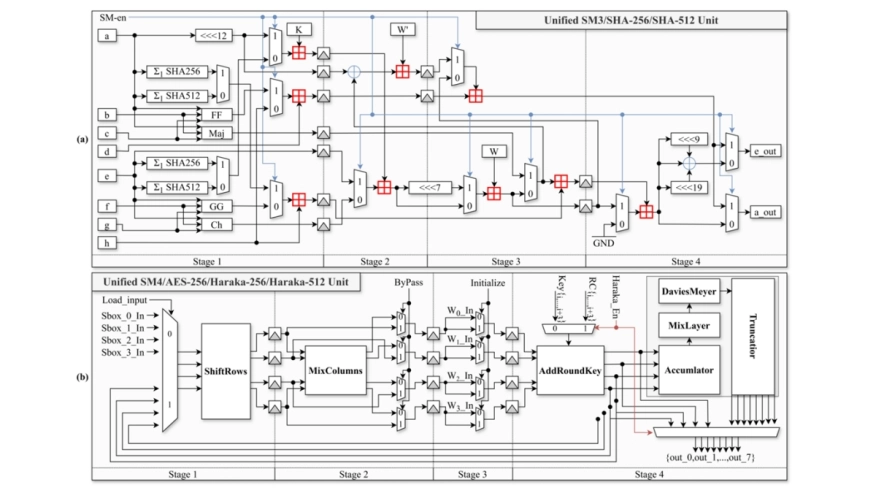
Cryptographic operations are critical for securing IoT, edge computing, and autonomous systems. However, current RISC-V platforms lack efficient hardware support for comprehensive cryptographic algorithm families and post-quantum cryptography. This paper presents Crypto-RV, a RISC-V co-processor architecture that unifies support for SHA-256, SHA-512, SM3, SHA3-256, SHAKE-128, SHAKE-256 AES-128, HARAKA-256, and HARAKA-512 within a single 64-bit datapath. Crypto-RV introduces three key architectural innovations: a high-bandwidth internal buffer (128x64-bit), cryptography-specialized execution units with four-stage pipelined datapaths, and a double-buffering mechanism with adaptive scheduling optimized for large-hash. Implemented on Xilinx ZCU102 FPGA at 160 MHz with 0.851 W dynamic power, Crypto-RV achieves 165 times to 1,061 times speedup over baseline RISC-V cores, 5.8 times to 17.4 times better energy efficiency compared to powerful CPUs. The design occupies only 34,704 LUTs, 37,329 FFs, and 22 BRAMs demonstrating viability for high-performance, energy-efficient cryptographic processing in resource-constrained IoT environments.
Index Terms — RISC-V, Cryptographic Accelerator, SHA 2/SHA-3, IoT, HARAKA
To read the full article, click here
Related Semiconductor IP
- RISC-V Debug & Trace IP
- RISC-V IOPMP IP
- Gen#2 of 64-bit RISC-V core with out-of-order pipeline based complex
- 64-bit RISC-V core with in-order single issue pipeline. Tiny Linux-capable processor for IoT applications.
- Multi-core capable RISC-V processor with vector extensions
Related Articles
- Design and implementation of a hardened cryptographic coprocessor for a RISC-V 128-bit core
- An FPGA-Based SoC Architecture with a RISC-V Controller for Energy-Efficient Temporal-Coding Spiking Neural Networks
- AutoTrans: AI-Assisted Automatic Translation of Security Assertions for RISC-V Processors
- Security coprocessor ties to PCI Express
Latest Articles
- Terracotta: Enabling the Adoption of New DRAM Techniques via a Flexible DRAM Interface and Memory Controller
- A Framework for Accelerating Transformer Inference on RISC-V for Edge AI
- An Interleaved Parallel Dependent Quantization Hardware Architecture for H.266/VVC
- A Formal Security Analysis of CAN XL
- A Secure dToF LiDAR SoC with Dual-Domain Fingerprinting and Event-Driven AFE Circuit Achieving Sensor-Level Attack Resilience