CircuitGuard: Mitigating LLM Memorization in RTL Code Generation Against IP Leakage
By Nowfel Mashnoor, Mohammad Akyash, Hadi Kamali, Kimia Azar
Department of Electrical and Computer Engineering (ECE), University of Central Florida, USA
Abstract
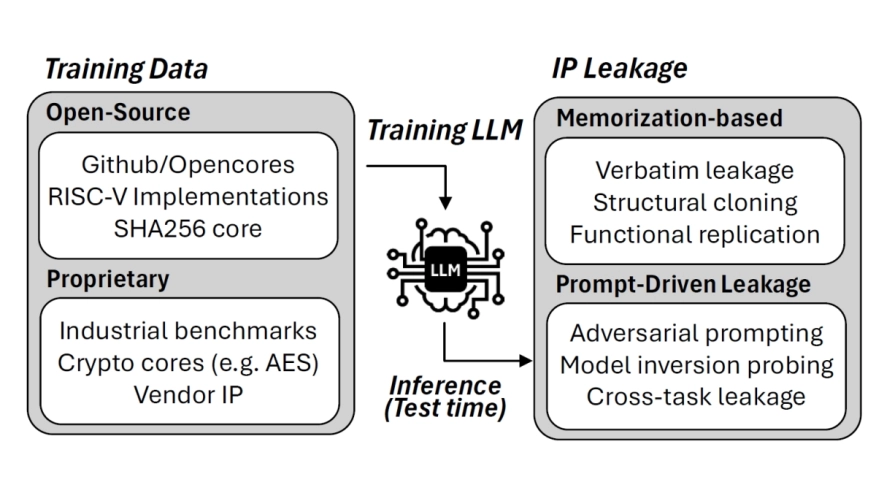
Large Language Models (LLMs) have achieved remarkable success in generative tasks, including register-transfer level (RTL) hardware synthesis. However, their tendency to memorize training data poses critical risks when proprietary or security-sensitive designs are unintentionally exposed during inference. While prior work has examined memorization in natural language, RTL introduces unique challenges: In RTL, structurally different implementations (e.g., behavioral vs. gate-level descriptions) can realize the same hardware, leading to intellectual property (IP) leakage (full or partial) even without verbatim overlap. Conversely, even small syntactic variations (e.g., operator precedence or blocking vs. non-blocking assignments) can drastically alter circuit behavior, making correctness preservation especially challenging. In this work, we systematically study memorization in RTL code generation and propose CircuitGuard, a defense strategy that balances leakage reduction with correctness preservation. CircuitGuard (1) introduces a novel RTL-aware similarity metric that captures both structural and functional equivalence beyond surface-level overlap, and (2) develops an activation-level steering method that identifies and attenuates transformer components most responsible for memorization. Our empirical evaluation demonstrates that CircuitGuard identifies (and isolates) 275 memorization-critical features across layers 18-28 of Llama 3.1-8B model, achieving up to 80% reduction in semantic similarity to proprietary patterns while maintaining generation quality. CircuitGuard further shows 78-85% cross-domain transfer effectiveness, enabling robust memorization mitigation across circuit categories without retraining.
To read the full article, click here
Related Semiconductor IP
- NPU IP
- JPEG XL Encoder
- I2C Master/Slave Controller Core
- NVMe Validation Test Suite
- Hybrid Memory Cube Verification IP
Related Articles
- Veri-Sure: A Contract-Aware Multi-Agent Framework with Temporal Tracing and Formal Verification for Correct RTL Code Generation
- Enabling RISC-V Vector Code Generation in MLIR through Custom xDSL Lowerings
- LLM4RTL: Tool-Assisted LLM for RTL Generation
- Commentary: Synopsys memory IP users seek RTL source code
Latest Articles
- Terracotta: Enabling the Adoption of New DRAM Techniques via a Flexible DRAM Interface and Memory Controller
- A Framework for Accelerating Transformer Inference on RISC-V for Edge AI
- An Interleaved Parallel Dependent Quantization Hardware Architecture for H.266/VVC
- A Formal Security Analysis of CAN XL
- A Secure dToF LiDAR SoC with Dual-Domain Fingerprinting and Event-Driven AFE Circuit Achieving Sensor-Level Attack Resilience