CANDoSA: A Hardware Performance Counter-Based Intrusion Detection System for DoS Attacks on Automotive CAN bus
By Franco Oberti 1, Stefano Di Carlo 2, Alessandro Savino 2
1 Dumarey, Italy
2 Politecnico di Torino, Italy
Abstract
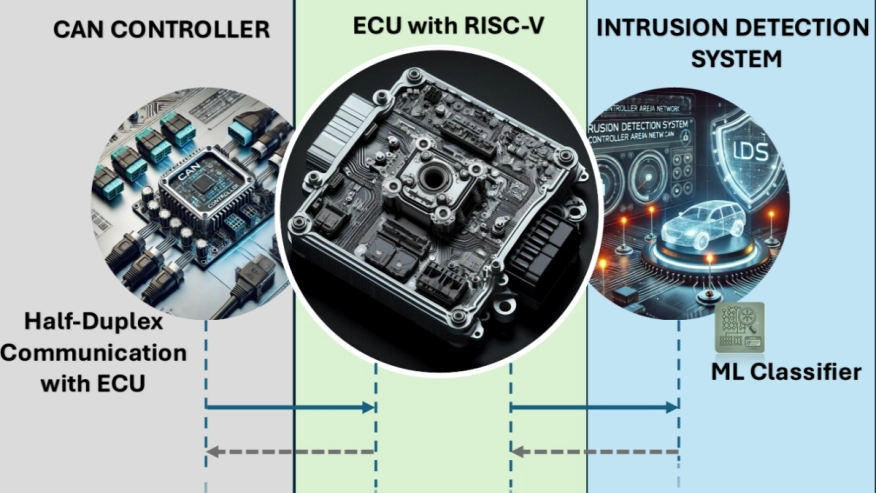
The Controller Area Network (CAN) protocol, essential for automotive embedded systems, lacks inherent security features, making it vulnerable to cyber threats, especially with the rise of autonomous vehicles. Traditional security measures offer limited protection, such as payload encryption and message authentication. This paper presents a novel Intrusion Detection System (IDS) designed for the CAN environment, utilizing Hardware Performance Counters (HPCs) to detect anomalies indicative of cyber attacks. A RISC-V-based CAN receiver is simulated using the gem5 simulator, processing CAN frame payloads with AES-128 encryption as FreeRTOS tasks, which trigger distinct HPC responses. Key HPC features are optimized through data extraction and correlation analysis to enhance classification efficiency. Results indicate that this approach could significantly improve CAN security and address emerging challenges in automotive cybersecurity.
To read the full article, click here
Related Semiconductor IP
- CAN Verification IP
- CAN - Verifies communication, error detection, and data integrity in CAN systems
- Controller Area Network with Flexible Data rate
- CAN
- CAN XL Verification IP
Related Articles
- Interstellar: Fully Partitioned and Efficient Security Monitoring Hardware Near a Processor Core for Protecting Systems against Attacks on Privileged Software
- A Survey on the Design, Detection, and Prevention of Pre-Silicon Hardware Trojans
- HW/SW Interface Generation Flow Based on Abstract Models of System Applications and Hardware Architectures
- How a Standardized Approach Can Accelerate Development of Safety and Security in Automotive Imaging Systems
Latest Articles
- Terracotta: Enabling the Adoption of New DRAM Techniques via a Flexible DRAM Interface and Memory Controller
- A Framework for Accelerating Transformer Inference on RISC-V for Edge AI
- An Interleaved Parallel Dependent Quantization Hardware Architecture for H.266/VVC
- A Formal Security Analysis of CAN XL
- A Secure dToF LiDAR SoC with Dual-Domain Fingerprinting and Event-Driven AFE Circuit Achieving Sensor-Level Attack Resilience