A Lightweight High-Throughput Collective-Capable NoC for Large-Scale ML Accelerators
By Luca Colagrande 1, Lorenzo Leone 1, Chen Wu 1, Tim Fischer 1, Raphael Roth 2, Luca Benini 1
1 Integrated Systems Laboratory (IIS), ETH Zurich, Zurich, Switzerland
2 D-ITET, ETH Zurich, Zurich, Switzerland.
Abstract
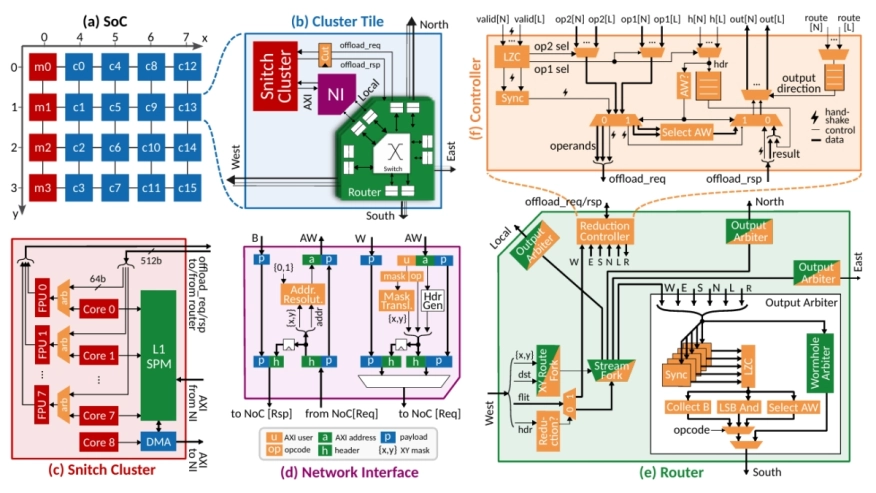
The exponential increase in Machine Learning (ML) model size and complexity has driven unprecedented demand for high-performance acceleration systems. As technology scaling enables the integration of thousands of computing elements onto a single die, the boundary between distributed and on-chip systems has blurred, making efficient on-chip collective communication increasingly critical. In this work, we present a lightweight, collective-capable Network on Chip (NoC) that supports efficient barrier synchronization alongside scalable, high-bandwidth multicast and reduction operations, co-designed for the next generation of ML accelerators. We introduce Direct Compute Access (DCA), a novel paradigm that grants the interconnect fabric direct access to the cores' computational resources, enabling high-throughput in-network reductions with a small 16.5% router area overhead. Through in-network hardware acceleration, we achieve 2.9x and 2.5x geomean speedups on multicast and reduction operations involving between 1 and 32 KiB of data, respectively. Furthermore, by keeping communication off the critical path in GEMM workloads, these features allow our architecture to scale efficiently to large meshes, resulting in up to 3.8x and 2.4x estimated performance gains through multicast and reduction support, respectively, compared to a baseline unicast NoC architecture, and up to 1.17x estimated energy savings.
To read the full article, click here
Related Semiconductor IP
- FlexGen Multi-Die Smart Network-on-Chip (NoC) IP
- NoC Interconnect IP Generator
- AXI NoC Non-Coherent Mesh
- FlexGen Smart Network-on-Chip (NoC) IP
- NoC System IP
Related Articles
- MeshKV: A Network-on-Chip KV Cache Fabric for Scalable Transformer Decoding Accelerators
- Tackling Network-on-Chip (NoC) Scaling Challenges with a System-technology Co-optimization Approach
- SynapticCore-X: A Modular Neural Processing Architecture for Low-Cost FPGA Acceleration
- A 0.32 mm² 100 Mb/s 223 mW ASIC in 22FDX for Joint Jammer Mitigation, Channel Estimation, and SIMO Data Detection
Latest Articles
- Minimum RISC-V: Maximum FPGA Efficiency
- The Era of Vibe Tapeout: Dark Age or Golden Age for Analog Circuit Design?
- Understanding the Power Consumption of Modern High Bandwidth Memory: Experimental Analysis and Modeling Using Real HBM2 DRAM Chips
- BARE-AI: Bit-Flip Attack Resilience in AI Hardware through Built-in Performance Monitors
- RFChipAgent: Multi-Agentic AI Flow for Analog/RF Chip Design