Overview
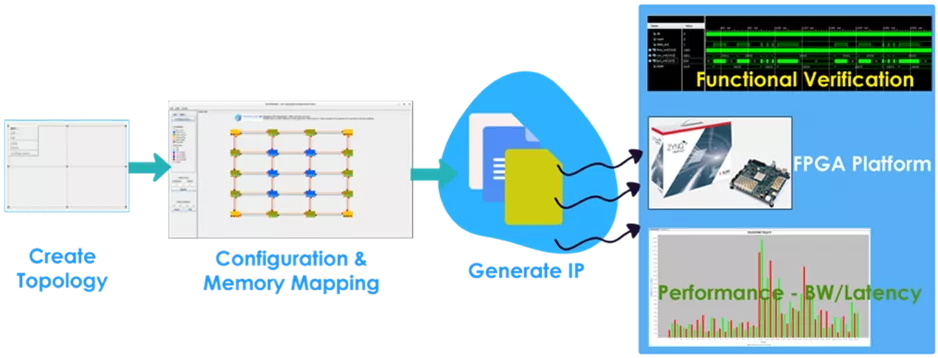
iNoCulator is a cloud-active EDA tool that is used to define the topology of a NoC quickly and easily, configure its parameters and simulate it to measure throughput and latency, power requirements and area. iNoCulatorTM enables interactive whiteboard editing of the NoC topology, through connection of initiators, routers and endpoints, and easy configuration. It supports on-the-fly instant simulation of bandwidth and latency, and estimation of power and area. iNoCulator provides pushbutton RTL generation with targets to an SoC design flow or to an FPGA emulation flow.
Learn more about Network-On-Chip IP core
A Network-on-chip (NoC) is a network inside a System-on-chip (SoC) that connects to all IO, Compute and Storage devices. In addition to its networking function, the NoC also needs to do well in terms of power, performance and area.
Ensuring Network-on-Chip (NoC) security is crucial to design trustworthy NoC-based System-on-Chip (SoC) architectures. While there are various threats that exploit on-chip communication vulnerabilities, eavesdropping attacks via malicious nodes are among the most common and stealthy. Although encryption can secure packets for confidentiality, it may introduce unacceptable overhead for resource-constrained SoCs.
Microcontrollers (MCUs) are no longer the humble workhorses of embedded systems. Today’s MCUs rapidly evolve into compact, high-performance computing platforms, integrating artificial intelligence (AI), advanced security features, and real-time processing into power-constrained environments.
In this article, we will dive deeper into a comprehensive methodology for formally verifying an NoC, showcasing the approaches and techniques that ensure our NoC designs are robust, efficient, and ready to meet the challenges of modern computing environments.
Many people have heard the term cache coherency without fully understanding the considerations in the context of system-on-chip (SoC) devices, especially those using a network-on-chip (NoC). To understand the issues at hand, it’s first necessary to understand the role of cache in the memory hierarchy.
In the world of system-on-chip (SoC) devices, architects encounter many options when configuring the processor subsystem. Choices range from single processor cores to clusters to multiple core clusters that are predominantly heterogeneous but occasionally homogeneous.