The Memory Challenge of Physical AI


Most AI hardware conversations start with compute, which is understandable since accelerators are visible, easy to compare, and often tied to headline performance metrics. Physical AI broadens that conversation by placing greater emphasis on how compute, memory, and data movement work together under real-world operating constraints. For intelligent systems that must see, interpret, decide, and act in the physical world in real time, it’s critical that the right data reaches the right engine at the right time.
As a result, data movement has become an increasingly important consideration when architecting physical AI systems. A physical AI device may simultaneously handle sensor streams, model weights, activations, temporary buffers, control loops, and safety functions. If memory access becomes unpredictable, compute engines can stall. Power consumption rises when data is moved too often, and poorly planned buffering can cause latency accumulation that is hard to recover from later.
As physical AI workloads become more complex, architects must now consider how predictably the complete system performs when multiple real-world workloads are active simultaneously.
Avoid Unnecessary Data Movement
Physical AI systems rely on a memory hierarchy that coordinates on-chip memory with larger-capacity external memory. LPDDR or GDDR may hold model weights, sensor data, activations, and other working data, while on-chip SRAM and cache keep the portions currently needed by the NPU, CPU, DSP, ISP, or other processing engines close to compute.
As workloads move through the processing pipeline, required data is transferred from external memory into on-chip memory, where it can be accessed and reused with lower latency and energy. The more effectively the architecture reuses that local data, the fewer times it must retrieve the same information from external memory. However, because SRAM and cache consume silicon area, their capacity is limited. Data that does not fit on-chip, or is used less frequently, remains in LPDDR or GDDR until it is needed.
This coordination is important because every unnecessary transfer across the memory hierarchy consumes energy, adds latency, and uses external-memory bandwidth. Physical AI systems are also constrained by device size, package complexity, power delivery, and thermal headroom. The goal is therefore not to eliminate external memory access, but to keep the right data close to compute for as long as it is useful and avoid moving it more often than necessary.
A well-planned dataflow coordinates compute engines, on-chip SRAM and cache, external LPDDR or GDDR, buffering, and interconnect around the workload. This helps keep compute resources productive while using external-memory capacity and bandwidth efficiently.
Real-World Applications Clarify the Tradeoffs
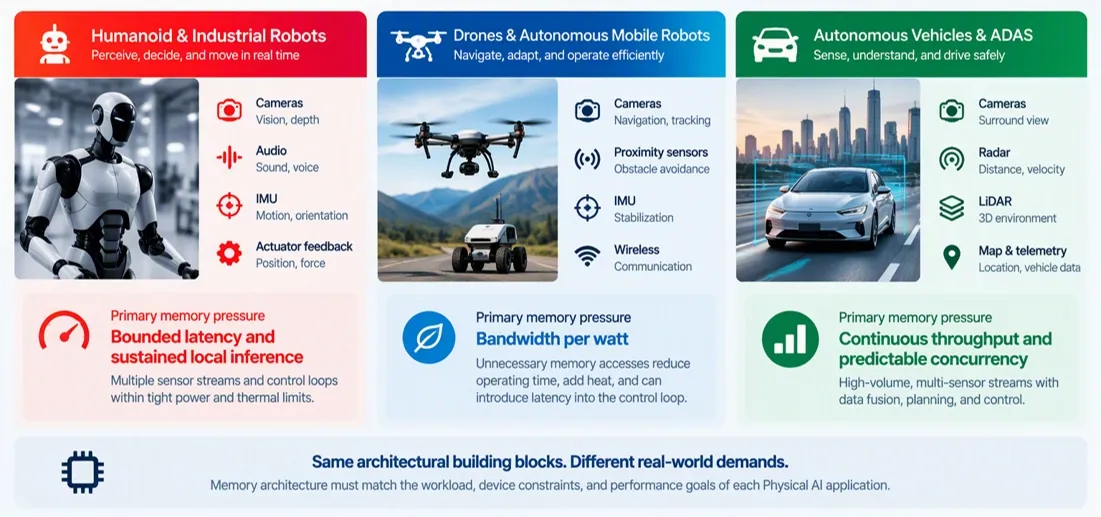
Humanoid robots, drones, autonomous vehicles, smart cameras, inspection robots, industrial robots, and autonomous mobile robots may all run local intelligence, yet each stresses memory and interfaces differently. Their architectures must determine which data should remain close to compute for immediate access and which should reside in higher-capacity external memory.
Humanoids may combine cameras, depth sensing, audio, inertial data, balance control, object recognition, path planning, and actuator feedback within a limited power and thermal envelope. If perception data arrives late, control decisions may be delayed. In addition, sustained performance drops and power rises if model weights and intermediate data are reloaded too often. In this kind of system, memory efficiency affects how smoothly the robot can perceive, decide, and move, all of which are key to successful real-time operation.
A drone or autonomous mobile robot has a different set of constraints. It may need visual navigation, obstacle avoidance, stabilization, object tracking, wireless communication, and video processing, all while staying within a limited power and thermal budget. Unnecessary external memory accesses reduce operating time, add heat, or introduce latency into the control loop. For these physical AI systems, bandwidth per watt is as important as raw bandwidth.
Autonomous vehicles and advanced driver assistance systems (ADAS) present an even greater challenge. With cameras, radar, lidar, ultrasonic sensors, vehicle telemetry, map data, and control functions, competition for memory access is fierce. Some data streams need continuous throughput, while others need fusion across sensor domains. Retaining relevant data long enough to support planning and decision-making is also an important consideration. In this environment, memory behavior affects both throughput and response predictability.
Memory Choices Must Follow the Workload
When building a memory architecture, architects should begin with the behavior of the physical AI workload itself. The objective is not simply to select the fastest external memory technology or provision the greatest possible bandwidth. It is to right-size the complete memory hierarchy, including local storage, external memory capacity, bandwidth, power, buffering, and integration, around the device’s data streams, reuse patterns, latency requirements, and operating constraints.
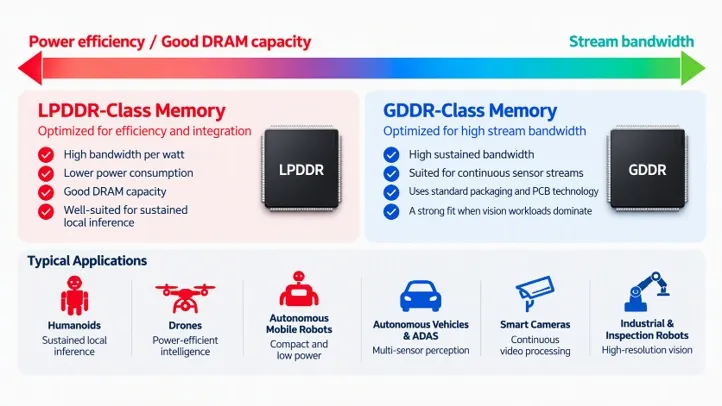
LPDDR and GDDR address different architectural priorities. LPDDR is often a strong fit when bandwidth per watt and memory capacity are needed to sustain local inference performance. When continuous image or sensor-stream bandwidth is the primary requirement, GDDR may be a viable option because its high bandwidth can meet those performance needs with fewer DRAM devices.
Available solutions give architects considerable flexibility in making this tradeoff. For example, Cadence offers
LPDDR6/LPDDR5X PHY and Controller IP supporting data rates up to 14.4Gbps, as well as GDDR7 PHY IP supporting data rates up to 36Gbps for high-bandwidth applications. These options allow the external memory interface to be aligned with the workload rather than treated as a one-size-fits-all design choice.
A humanoid robot may prioritize power-efficient access to model weights, perception data, and control information. A smart camera or autonomous-vehicle perception processor may place greater pressure on sustained vision-stream bandwidth. In each case, the architecture should keep frequently reused and latency-sensitive data close to compute while selecting an external memory interface sized for the remaining capacity and bandwidth requirements. This helps avoid both memory bottlenecks and unnecessary over-provisioning.
|
Device context |
Examples |
Primary pressure |
Likely memory fit |
|
Mobile physical AI devices |
Humanoids, drones, autonomous mobile robots, robotic modules |
Sustained local inference under size, capacity, bandwidth, and latency limits |
LPDDR for bandwidth-per-watt and high DRAM capacity design; GDDR selectively for heavy vision streams |
|
Vision-heavy physical AI devices |
Autonomous vehicles, smart cameras, inspection robots, industrial vision systems |
Continuous image or sensor streams with predictable response |
LPDDR where memory capacity matters; GDDR when stream bandwidth dominates |
Five Memory Architecture Decisions
Before selecting an external memory interface, architects should evaluate how the device’s dataflow and operating constraints affect five key areas:
- Data locality: Which data should remain close to compute to meet latency, reuse, and energy-efficiency requirements, and which data should reside in external memory?
- Traffic contention: Where will sensor, inference, software, safety, and control traffic contend for memory access?
- External memory fit: Which external memory option best matches the device’s bandwidth, power, and integration needs?
- Buffering strategy: How much local storage and buffering are needed to reuse data effectively and avoid unnecessary off-chip movement?
- Latency predictability: Can the device keep latency bounded when multiple workloads are active?
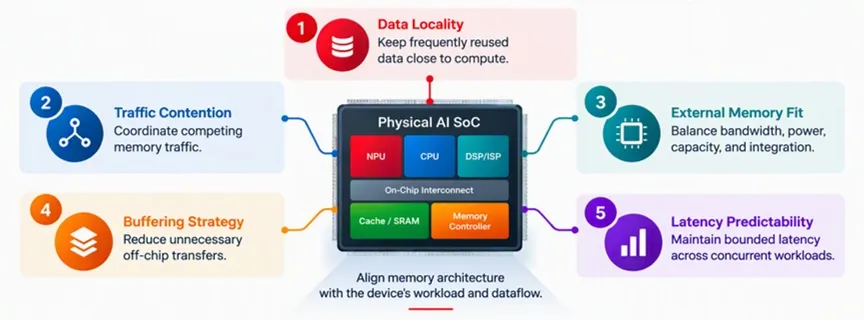
A balanced memory architecture aligns data locality, traffic management, external memory selection, buffering, and latency predictability with the device workload. Together, these decisions help reduce unnecessary data movement, keep compute resources productive, and maintain predictable performance when multiple workloads operate concurrently.
Explore Cadence IP
Conclusion
Physical AI places intelligence inside devices that operate continuously, interact with real-world signals, and respond under power, thermal, latency, and reliability constraints. Meeting these demands requires compute, memory, and data movement to function as a coordinated system. Predictable data movement is crucial for physical AI devices to operate effectively under real-world conditions, making memory architecture an important part of the overall design. Selecting the right memory requires a careful balance of latency, power efficiency, bandwidth, buffering, and workload requirements. Architects must keep frequently used data close to the engines that need it, use external bandwidth efficiently, keep compute resources productive, and maintain predictable system behavior as workloads operate concurrently.
Learn more about how to architect physical AI systems with design IP in Cadence’s “Designing Physical AI Systems Under Real-World Constraints” white paper.
Related Semiconductor IP
- Highly scalable performance for classic and generative on-device and edge AI solutions
- MIPI CSI-2 TX Controller
- 1.6T Ultra Ethernet Controller
- HBM4E PHY and controller
- DDR5 MRDIMM PHY and Controller
Related Blogs
- Rivian’s autonomy breakthrough built with Arm: the compute foundation for the rise of physical AI
- The Rise of Physical AI: When Intelligence Enters the Real World
- The Silent Guardian of AI Compute - PUFrt Unifies Hardware Security and Memory Repair to Build the Trust Foundation for AI Factories
- The Rise of Physical AI and Robotics: Why Hardware-Based Security is Non-Negotiable