AI-Generated UVM Testbenches from SoC Specifications

AI can now generate a UVM testbench directly from a verified SoC specification, replacing much of the repetitive setup work with a structured starting point that engineers can review.
 Verification is where chip schedules are won or lost. Before a single meaningful test runs, a team has to build the environment: agents, monitors, drivers, sequences, checkers, and coverage. Much of that work repeats from project to project, and all of it depends on someone reading the specification correctly.
This article explains why building testbenches by hand is so slow, why the specification is the right place to start, and what an AI-generated flow looks like in practice.
Why Hand-Built UVM Testbenches Take So Long
UVM gives teams a standard methodology, but it does not write the testbench for them. Three things make the manual route slow.
- The boilerplate is large. Monitors, drivers, sequencers, environments, and register models follow familiar patterns, yet each one still has to be written, connected, and debugged for every design.
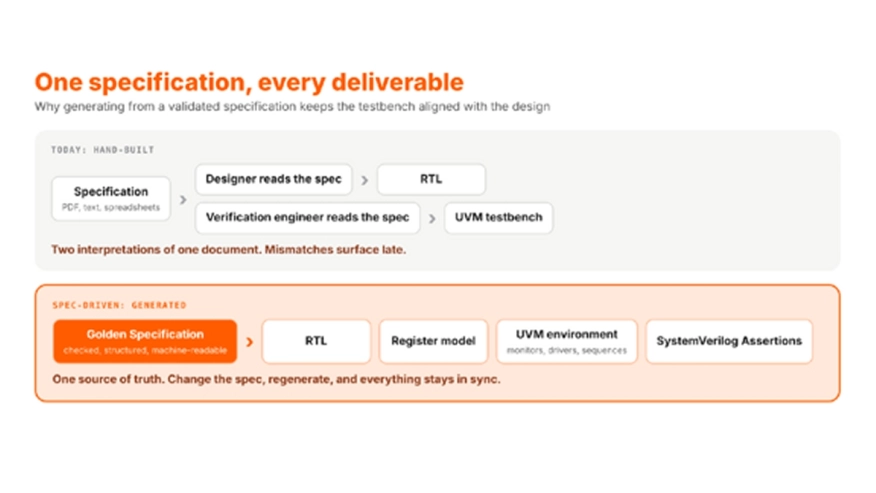
- Everything starts from a human reading of the spec. The RTL designer and the verification engineer each interpret the same document. If their readings differ, the testbench checks the wrong behavior, or misses the right one.
- Specifications keep changing. Every revision ripples into the design, the verification environment, the test sequences, and the coverage plan, and someone has to find and update each change location by hand.
Coverage closure adds to the load. After the environment works, the team still has to write and refine sequences until the coverage goals are met, which can take a large share of the verification schedule.
Why the Specification Is the Right Starting Point
Industry studies of functional flaws keep pointing to the same source: incorrect, incomplete, or changing specifications. A bug that starts in the spec travels into the RTL and then into the testbench, where it can pass every check because the testbench inherited the same mistake.
That makes the specification the natural source for generation, with one condition: it has to be structured, correct, and complete before anything is generated from it. Many specifications live in PDFs, text files, and spreadsheets, written in natural language that is ambiguous and hard for tools to process.
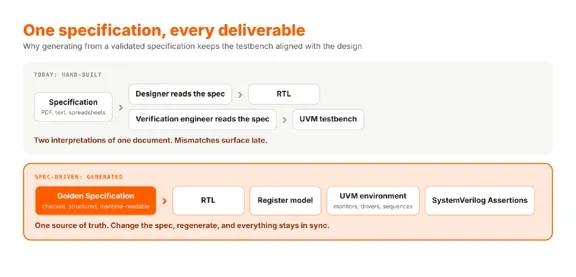
Teams that treat a validated, machine-readable specification as the single source of truth, often called a golden specification, can generate RTL, register models, and verification environments from the same place. The testbench then reflects the intended behavior of the design, not one engineer’s interpretation of it.
What an AI-Generated Testbench Flow Looks Like
The details differ by tool, but a spec-driven flow generally follows five steps:
- Check the specification. Validate it for correctness, completeness, and consistency, so errors are caught before they reach the testbench.
- Structure the design intent. Convert PDFs, text, and other inputs into machine-readable information such as registers, Finite State Machines (FSM), interfaces, and control and dataflow logic.
- Generate the environment. Create the monitors, drivers, and sequences from the structured specification, along with tests and SystemVerilog Assertions (SVA).
- Drive coverage. Generate sequences aimed at closing coverage, and capture any custom scenarios your team wants to add.
- Run, review and refine. Simulation results are only useful when you can quickly see what went wrong, so look for tools that summarize outcomes and report issues in a structured way.
Engineers stay in charge throughout. The AI produces the first version quickly, and the team reviews and steers its refinement.
What to Look for in AI-Generated Verification
A general-purpose AI assistant can write a UVM snippet. Generating a complete, trustworthy environment is a bigger job. Five questions help separate real automation from code suggestions:
- Does it start from your specification? Output grounded in a validated spec stays consistent with the design. Output from a loose prompt does not.
- Is the output readable, standard UVM? Your team should be able to review, modify and run it in the simulators you already use.
- Can you trace it back to the spec? Each component and test should map to a requirement, so reviews are fast and changes are easy to follow.
- Does it work toward coverage? Look for generation aimed at your coverage goals, not just a testbench skeleton.
- Can you add your own scenarios? Generated sequences cover the common cases. Your corner cases still need a simple way in.
Where IDS-AI Fits
Agnisys IDS-AI is one example of this spec-driven approach. It is a multi-agent AI framework built around a golden specification, and it covers the steps above with specialized agents:
- The Extract Agent turns PDF, text, HTML, and Markdown inputs into structured design information.
- The Spec Check Agent checks the specification for correctness, completeness, and consistency.
- The Verification Agent creates the entire verification environment, including monitors, drivers and sequences, along with the sequences to drive coverage toward 100%. Custom sequences can be captured through GUI templates.
- The SV Assertion Agent generates SVAs and the formal verification environment.
- The Summary/Debug Agent analyzes simulation results, summarizes the outcomes, and generates a structured report of the issues found. It can also use those findings to help investigate mismatches between the specification and the RTL.
Because every agent works from the same golden specification, the RTL, testbench, and assertions stay aligned every time the spec changes.
To see how it works, explore IDS-AI.
Related Semiconductor IP
- I3C Full Controller / Target
- I3C HCI Host Controller
- USB-C Power Delivery IP Core
- Configurable Multi-Channel DMA Controller
- Samsung Foundry 4nm 1V8 GPIO I3C
Related Blogs
- SoC QoS gets help from machine learning
- 5 Strategies for Protecting Your Advanced SoC Designs from Security Breaches
- Statistical Profile Extension: extracting value from SPE for SoC Telemetry
- From Spec to Silicon: Accelerate SoC Integration with IP-XACT
Latest Blogs
- TDISP and Confidential Computing: Extending the PCIe Chain of Trust
- AI-Generated UVM Testbenches from SoC Specifications
- Generating Chip Subsystems Automatically: A New Answer to Manage Chip Design Complexity
- Agentic AI Should Fit the Way You Engineer
- Listening at the Speed of Memory: Live Speech Recognition on Chimera