Preparing for the EU CRA with hardware security verification

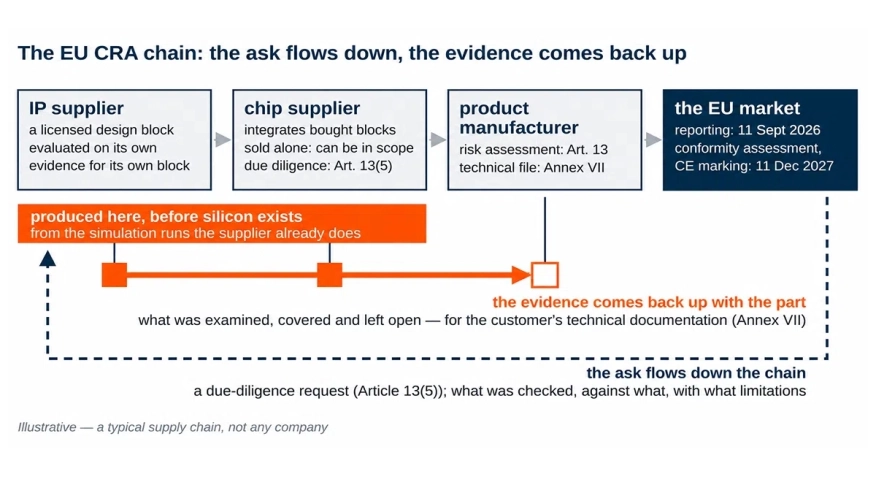 Manufacturers selling products covered by the EU Cyber Resilience Act (CRA) need to understand what components those products contain and how they affect security. Manufacturers preparing for the CRA’s main requirements can use security verification results to document what was checked, what the findings indicate, and what remains outside the evaluation’s scope. Evidence from semiconductor intellectual property (IP) and chip companies can help manufacturers assess risk and develop required technical documentation.
Functional verification checks whether a design behaves as intended. Security verification adds questions about where protected information can travel and what can influence it. Information-flow analysis can complement functional verification and formal methods by helping engineers track how information about a protected asset moves through a design.
Define the requirement
To verify a design’s security, the development team needs to define security requirements that can be checked. Engineers then check the design against those requirements to produce supporting evidence. This starts with identifying the information the design needs to protect, called an asset. Examples include cryptographic keys, configuration settings, or machine-learning model weights.
Engineers define a protection boundary by identifying which blocks or interfaces need access to the asset, what they need to do, and under what conditions. For example, a cryptographic key may need to reach the logic that uses it while remaining unavailable to unrelated blocks. Information-flow analysis lets engineers track the key through the design to check whether it stays within that protection boundary. If it does not, the resulting path gives the team a specific behavior to investigate.
To read the full article on EDN, click here.
Explore Arteris IP
Related Semiconductor IP
- FlexGen Multi-Die Smart Network-on-Chip (NoC) IP
- FlexGen Smart Network-on-Chip (NoC) IP
- FlexWay Interconnect IP
- Ncore Multi-Die Interconnect IP
- Magillem Registers
Related Blogs
- The Silent Guardian of AI Compute - PUFrt Unifies Hardware Security and Memory Repair to Build the Trust Foundation for AI Factories
- Beyond Trusted: What the NSA’s New Guidance Means for Hardware Security
- Importance Of Hardware Security Verification In Pre-Silicon Design
- Universal Browser Support for JPEG XL: Is Your Hardware Ready for the New Standard?