Importance Of Hardware Security Verification In Pre-Silicon Design

Today’s semiconductor chips run cloud infrastructure, automotive controllers, industrial robots, and edge AI processors, so effectively the entire technology market. Engineers must now ensure that silicon itself defends against attacks, protects embedded secrets, and complies with increasingly stringent global security standards, such as ISO/SAE 21434 and the EU Cyber Resilience Act. Regulators, partners, customers, hyperscalers, and end-product developers now expect proof that security was built in during the architecture phase. Every transistor now carries a burden of trust that extends throughout the entire development process. This requires a systematic approach to security throughout the pre-silicon development cycle, using verification to uncover weaknesses and evaluate effectiveness.
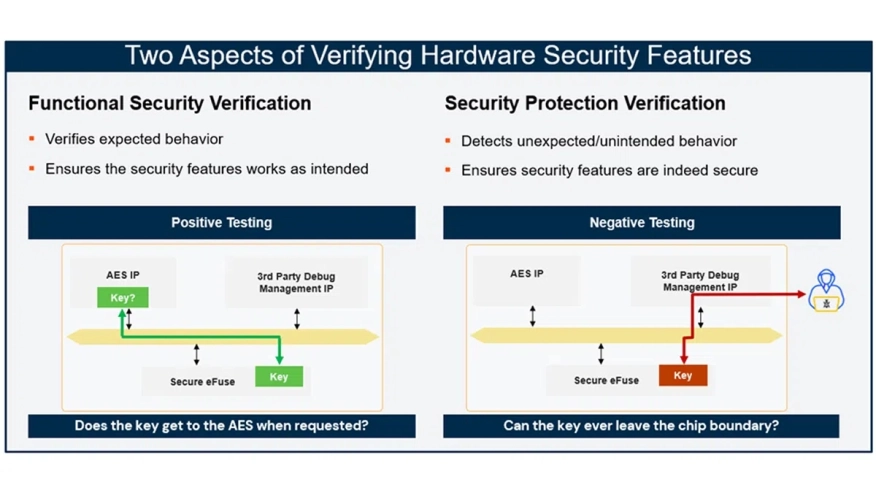 Security coverage provides a structured, measurable method for evaluating functionality and protections, identifying vulnerabilities, and verifying processes. This enables engineering teams to assess how thoroughly security controls are exercised and to detect potential gaps throughout the design lifecycle. The real challenge is knowing with confidence that defined assets, constraints, and protection boundaries are correctly enforced and remain effective.
Two necessary pillars
Hardware security comes down to two core pillars. Functional security verification confirms correctness, and security protection verification establishes robustness.
The functional security verification pillar ensures that security functionality behaves correctly under defined operating conditions and expected use cases. It uses known methods such as simulation, assertions, and formal analysis.
To read the full article on Semiconductor Engineering, click here.
Related Semiconductor IP
- FlexGen Smart Network-on-Chip (NoC) IP
- FlexNoC Interconnect IP
- FlexGen Multi-Die Smart Network-on-Chip (NoC) IP
- NoC Interconnect IP Generator
- NoC Silicon IP for RISC-V based chips supporting the TileLink protocol
Related Blogs
- Why Hardware Security Is Just as Critical as Software Security in Modern Systems
- Programmable Hardware Delivers 10,000X Improvement in Verification Speed over Software for Forward Error Correction
- Verification Sanity in Chiplets & Edge AI: Avoid the “Second Design” Trap
- AI in Design Verification: Where It Works and Where It Doesn’t
Latest Blogs
- Tape-Out Readiness Checklist: Engineering Decisions That Prevent Costly Respins
- How Cadence DSPs Put In-Cabin AI Audio On-Chip in SemiDrive's X10
- The Fastest Path to Scalable Photonic Systems: Using Proven IP for both PIC and EIC designs
- Building Trusted AI Agents from the Silicon Root of Trust
- Heterogeneous Computing in Space