High-Speed SerDes Design: Architecture, Equalization, and CDR Circuits

The demand for high-bandwidth communication is increasing across a wide range of applications. Data centers, networking equipment, automotive platforms, high-performance computing systems, and chiplet-based architectures all require the ability to move large volumes of data quickly and reliably. While advances in processing technology have significantly improved computing performance, communication between devices, memory subsystems, and functional blocks has become equally important.
But as the data rates continue to rise, traditional interconnect approaches face growing challenges related to Performance, power, and area.
High-Speed Serializer/Deserializer (SerDes) technology addresses these challenges by enabling efficient communication over fewer high-speed links. By converting parallel data into a serial stream for transmission and reconstructing it at the receiving end, SerDes improves bandwidth efficiency while reducing interconnect complexity.
Today, High-Speed SerDes serves as the foundation of industry standards such as PCIe, Ethernet, USB, and UCIe, making it a critical technology for modern semiconductor systems. As the industry progresses towards higher data rates and increasingly complex architectures, SerDes continues to play a central role in enabling reliable and scalable connectivity, especially at lower nodes.
Key specifications and signal integrity considerations for SerDes
The performance of a High-Speed SerDes interface is determined by more than just data rate. Reliability, power efficiency, latency, and signal quality all influence how effectively a system can support modern bandwidth requirements.
The industry has steadily advanced from 10G and 32G implementations to 56G, 112G, and emerging 224G SerDes solutions. While higher speeds enable greater bandwidth, they also introduce new design challenges. Signal attenuation, timing uncertainty, and channel losses become increasingly difficult to manage as operating frequencies rise.
Power consumption is another critical consideration. Modern systems often deploy hundreds or even thousands of high-speed links, making power-efficient SerDes design essential for reducing overall energy consumption and easing thermal management challenges. PJ/bit tells you how much energy is consumed to transmit one bit of data across the link.
Reliability is commonly measured through Bit Error Rate (BER), which reflects the accuracy of data transmission. Maintaining a low BER requires careful management of jitter, crosstalk, insertion loss, and power supply noise, all of which can affect signal quality.
As signals travel through semiconductor packages, PCB traces, connectors, cables, and die-to-die interconnects, they naturally degrade. Maintaining signal integrity across these communication channels is one of the primary challenges in High-Speed SerDes design and a key factor in achieving reliable system performance.
Understanding SerDes architecture
A High-Speed SerDes architecture consists of a transmitter, a communication channel, and a receiver working together to move data efficiently.
The overall data flow can be represented as:
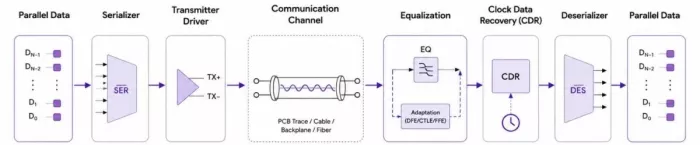
The serializer converts incoming parallel data into a high-speed serial stream. This significantly reduces the number of physical interconnects required while maintaining high data throughput.
The transmitter driver then prepares the signal for transmission across the communication channel. Depending on the application, the channel may consist of package interconnects, PCB traces, connectors, cables, optical modules, or die-to-die links within advanced semiconductor packages.
When the signal travels through the channel, it encounters losses and distortions that can impact communication quality. Hence, we use FFE in the driver circuit to reduce the distortions before it enters the lossy channel. At the receiving end, equalization techniques help compensate for these impairments, while Clock Data Recovery (CDR) circuits reconstruct the timing information required for accurate data sampling.
The Deserializer then converts the recovered serial stream back into parallel data for processing by the system.
The effectiveness of a SerDes solution depends not only on the performance of individual functional blocks but also on how they operate together as a complete system. Architectural decisions are influenced by bandwidth requirements, channel reach, protocol standards, packaging technologies, and power targets. In modern ASIC design, these considerations play a critical role in determining overall system performance, making SerDes architecture an essential component of next-generation SoCs and custom silicon platforms.
Equalization and CDR circuits
One of the biggest challenges in high-speed communication is signal degradation. When data travels through a communication channel, higher-frequency components typically experience greater attenuation than the lower-frequency components. This can distort the signal and make it more difficult for the receiver to accurately interpret incoming data.
Equalization techniques are used to compensate for these channel losses and improve signal clarity. Depending on the system requirements, equalization may be implemented at the transmitter, receiver, or both.
Feed-Forward Equalization (FFE) is commonly used at the transmitter to shape the signal before transmission and compensate for expected channel losses. At the receiver, Continuous-Time Linear Equalization (CTLE) helps correct frequency-dependent attenuation, while Decision Feedback Equalization (DFE) reduces interference caused by previously received symbols.
Together, these equalization techniques help restore signal quality, enabling reliable communication over longer distances and at higher data rates.
Accurate timing is equally important. Many high-speed interfaces do not transmit a dedicated clock signal alongside the data stream. Instead, the receiver must extract timing information directly from the incoming data.
Clock Data Recovery circuits perform this function by tracking data transitions and recreating the timing reference required for sampling. Without effective clock recovery, even a strong signal may be interpreted incorrectly due to timing errors.
As SerDes speeds continue to increase, both equalization and CDR circuits become increasingly important for maintaining signal integrity, reducing error rates, and ensuring reliable communication.
Applications of high-speed SerDes
High-speed SerDes technology has become a fundamental building block across multiple industries.
- Data centers and high-performance computing: SerDes enables high-speed communication between servers, storage systems, networking equipment, processors, accelerators, and memory subsystems. These high-bandwidth links support demanding workloads while ensuring efficient data movement across increasingly complex computing platforms.
- Networking and telecommunications: Routers, switches, optical transport systems, and wireless communication infrastructure depend on high-speed interfaces to manage increasing volumes of data traffic.
- Automotive electronics: In Advanced Driver Assistance Systems (ADAS), autonomous driving platforms, cameras, radar sensors, and centralized vehicle architectures all depend on reliable high-speed communication between distributed electronic components.
Future Trends in SerDes Design
As the semiconductor industry moves toward 224G implementations and beyond, maintaining signal integrity while controlling power consumption will become increasingly challenging.
One of the most significant developments is the adoption of PAM4 signalling. By transmitting more information within the same channel, PAM4 enables higher bandwidth without proportionally increasing operating frequency. However, this approach also introduces new challenges related to noise tolerance, equalization, and error management.
Advanced packaging technologies are also reshaping connectivity requirements. As heterogeneous integration and chiplet-based architectures become more common, efficient die-to-die communication is emerging as a critical design requirement.
Another area gaining momentum is Co-Packaged Optics (CPO). As copper interconnects approach practical performance limits, optical communication is moving closer to processing devices. This approach has the potential to reduce transmission losses, improve bandwidth scalability, and support the next generation of high-performance systems.
Future SerDes innovations will focus not only on increasing speed but also on improving power efficiency, signal integrity, and connectivity across increasingly complex semiconductor platforms.
To sum up, as bandwidth requirements continue to increase across semiconductor systems, reliable high-speed connectivity has become a fundamental design requirement. High-Speed SerDes enables efficient data transfer between devices, memory subsystems, and processing elements, making it a critical technology for next-generation electronic systems. Through a combination of optimized architecture, effective equalization techniques, and accurate clock recovery mechanisms, SerDes solutions help overcome the challenges associated with increasing data rates and complex communication channels.
MosChip’s Silicon Design services include High-Speed SerDes Design and Layout capabilities, supporting complex designs, IP integration, customization, and porting across advanced process nodes. Our capabilities include High-Speed SerDes design up to 112 Gbps, AMS simulations, behavioral modeling, IO characterization, ESD and EMIR analysis, reliability verification, and physical implementation. With experience across advanced FinFET technologies and established design methodologies, MosChip helps accelerate the development of high-performance connectivity solutions for next-generation semiconductor systems.
Related Semiconductor IP
- SerDes
- 1.25G - 12.5G SERDES
- Multiprotocol SerDes PMA
- SerDes Hard Macro-IP in GlobalFoundries 22FDX
- Programmable PCIe2/SATA3 SERDES PHY on TSMC CLN28HPC
Related Blogs
- Relationship between architecture and validation in system design
- Design Approaches and Architectures of RISC-V SoCs
- The Future of High-Speed SerDes
- Demystifying PCIe PIPE 5.1 SerDes Architecture
Latest Blogs
- From Bug Hunting to Engineering Methodology: Lessons from AI-Driven Development
- Manufacturing Intelligence: Turning EDA Data into Trusted Action
- Execute-in-Place: Getting More from Embedded NVM
- Rethinking RTL flows with AI-driven hybrid formal verification
- Arm and NVIDIA: Building the trusted compute foundation for the agentic AI era