Vendor: Analog Bits Inc. Category: Multi-Protocol PHY

Programmable PCIe2/SATA3 SERDES PHY on TSMC CLN28HPC

The Programmable SERDES provides a Physical Media Attachment (PMA) Layer capable of signaling at multiple data rates and supports…

PHY TSMC 28nm HPC Available on request View all specifications

Overview

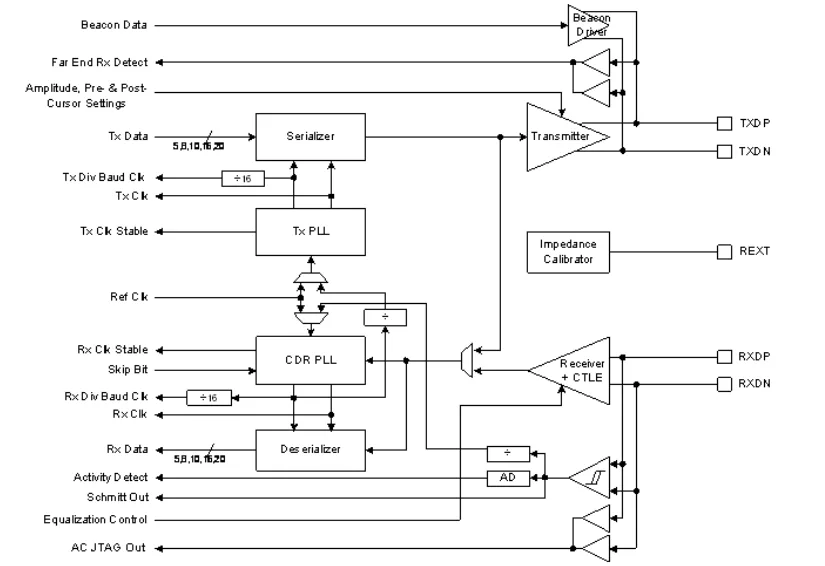
The Programmable SERDES provides a Physical Media Attachment (PMA) Layer capable of signaling at multiple data rates and supports multi-protocol market needs including a wide range of ac- coupled high-speed serial communication standards requiring serial Clock Data Recovery (CDR). The pin-configurable macro uses standard logic process devices, and exhibits exceptional input sensitivity, input jitter tolerance and low output jitter. Analog Bits’ proprietary and industry leading PLL technology in combination with sophisticated circuit techniques and innovative IO design makes this macro an extremely area and power efficient solution. The PMA can be integrated with the available PCS to provide a PCI-Express Gen1/Gen2 PHY solution, and has interface capability to allow integration with other customer-designed serial protocol PCS layers.

Key features

  • Programmable SERDES analog front end that supports 1 to 6+ Gbps standard serial protocols
  • Compact form factor – 0.116 mm2 active silicon area per lane including ESD
  • Industry leading low power – typically 6.3 mW/Gbps (@6Gbps) including termination
  • Minimal latency – 3 UI between parallel transfer and serial transmission
  • Single-lane macro scalable to various link widths – x1, x2, x4, x8, x16, etc.
  • Finely configurable driver impedance, amplitude and 3-tap pre-emphasis
  • Finely configurable receiver impedance, CTLE gain and bandwidth
  • Selectable parallel data bit widths such as 5, 8, 10, 16, 20
  • Test support features such as ac-JTAG, near-end loopback, PLL bypass modes, etc.
  • Protocol-compatible features such as Tx detect Rx, LOS, independent Tx/Rx rate, power modes, etc.
  • Low pin-count and suitable for a variety of flip-chip and wire-bond packages
  • Metallization scheme and pad/bump structures customizable to specifications
  • Available with PCS to provide PIPE compatible PCI-Express Gen1/Gen2 PHY solution

Block Diagram

Silicon Options

Foundry Node Process Maturity
TSMC 28nm HPC Available on request

Specifications

Identity

Part Number
Programmable PCIe2/SATA3 SERDES PHY on TSMC CLN28HPC
Vendor
Analog Bits Inc.
Type
Silicon IP
Controller / PHY
PHY

Files

Note: some files may require an NDA depending on provider policy.

Provider

Learn more about Multi-Protocol PHY IP core

How a 16Gbps Multi-link, Multi-protocol SerDes PHY Can Transform Datacenter Connectivity

Increasingly, more of the focus on mobile has centered around cloud datacenters and the networking to get the data back and forth between these datacenters and the mobile device. Functions like voice recognition and mapping depend on the ability to split the functionality between the smartphone, for local processing like encryption and compression, and the back end, where a large number of servers can do the heavier lifting before returning the results.

One PHY, Zero Tradeoffs: Multi-Protocol PHY for Edge AI Interface Consolidation

The Cadence 10G multi-protocol PHY was architected to address this exact challenge. Designed to scale across multiple process nodes, it consolidates PCI Express (PCIe), USB, DisplayPort, Ethernet, and other interfaces into a single, compact, silicon-efficient block. What sets it apart is simultaneous multi-protocol support, which enables multiple data paths without duplicating hardware, requiring extra board connectors, or paying the area and power penalty of separate IP blocks.

Frequently asked questions about Multi-Protocol PHY IP cores

What is Programmable PCIe2/SATA3 SERDES PHY on TSMC CLN28HPC?

Programmable PCIe2/SATA3 SERDES PHY on TSMC CLN28HPC is a Multi-Protocol PHY IP core from Analog Bits Inc. listed on Semi IP Hub. It is listed with support for tsmc Available on request.

How should engineers evaluate this Multi-Protocol PHY?

Engineers should review the overview, key features, supported foundries and nodes, maturity, deliverables, and provider information before shortlisting this Multi-Protocol PHY IP.

Can this semiconductor IP be compared with similar products?

Yes. Buyers can compare this product with similar semiconductor IP cores or IP families based on category, provider, process options, and structured technical specifications.

×
Semiconductor IP