Relationship between architecture and validation in system design

In high-volume consumer electronics, the margin between a feature and a failure mode is increasingly narrow.
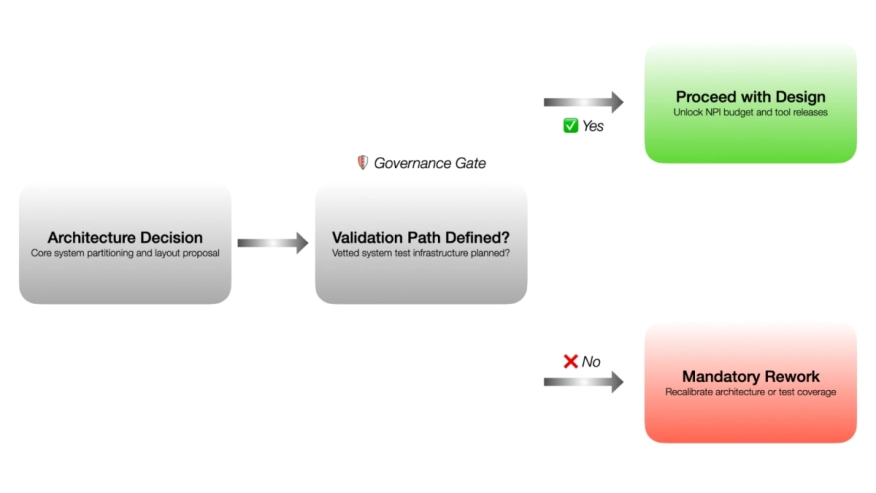 As the architecture of form-factor constrained devices becomes more tightly integrated, the traditional modularity of hardware systems breaks down. Thermal behavior, RF performance, mechanical tolerances, and power delivery are no longer independent domains because small sub-system shifts cascade across the entire system.
When the thermal envelope of a system-on-chip (SoC) directly impacts the signal integrity of a nearby 5G antenna, or when a mechanical tolerance stack-up in a camera module creates parasitic capacitance on a display flex, validation can no longer be a post-design activity.
Today, the complexity of modern hardware validation is a direct consequence of early architectural decisions. As highlighted in McKinsey’s analysis on handling technical complexity, upfront product architecture misjudgements inevitably compound into severe downstream bottlenecks during the integration phase.
To read the full article, click here
Related Semiconductor IP
- OpenTitan-based RISC-V Secure Element
- TSMC 40nm 5V GPIO
- Low Power 32kHz Pierce Oscillator
- Time-Sensitive Networking (TSN) End Point DO-254 IP Core
- TSMC 22nm 1.0V, 1.2V & 1.8V GPIO
Related Blogs
- The Integrated Design Challenge: Developing Chip, Software, and System in Unison
- Analog Design and Layout Migration automation in the AI era
- 2025 Year in Review: Design Wins, Advanced Nodes, and Expanding Markets
- Saving Time and Increasing Design Accuracy with System Verilog Assertions
Latest Blogs
- Arm and NVIDIA: Building the trusted compute foundation for the agentic AI era
- Trusted Autonomy with Cadence Super Agents & NVIDIA Open Agent Safety Platform
- One Processor, One Toolchain
- Akida Execution in Heterogeneous Environments - Clone It, Build It, Run It
- Inside TSMC’s Evolving Design Ecosystem: Shaping the Future of AI, with AI