AI workloads demand smarter SoC interconnect design

Artificial intelligence (AI) is transforming the semiconductor industry from the inside out, redefining not only what chips can do but how they are created. This impacts designs from data centers to the edge, including endpoint devices such as autonomous driving, drones, gaming systems, robotics, and smart homes. As complexity pushes beyond the limits of conventional engineering, a new generation of automation is reshaping how systems come together.
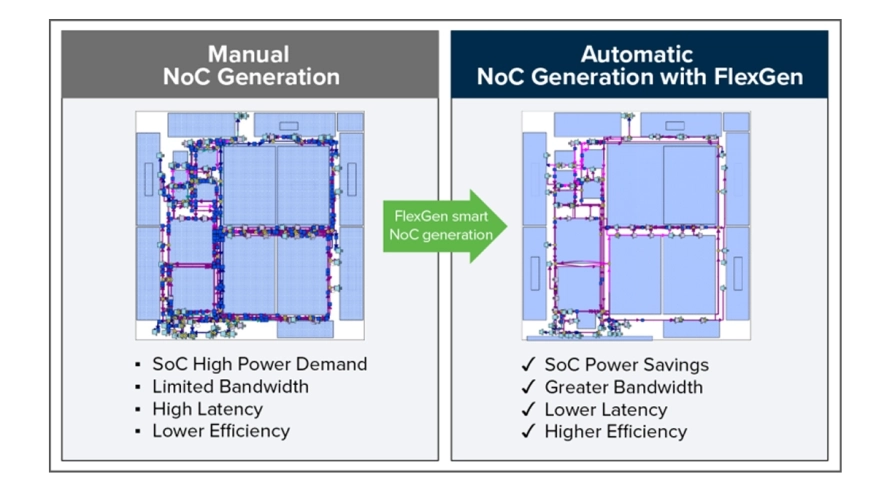 Instead of manually placing every switch, buffer, and timing pipeline stage, engineers can now use automation algorithms to generate optimal network-on-chip (NoC) configurations directly from their design specifications. The result is faster integration and shorter wirelengths, driving lower power consumption and latency, reduced congestion and area, and a more predictable outcome.
Below are the key takeaways of this article about AI workload demands in chip design:
- AI workloads have made existing SoC interconnect design impractical.
- Intelligent automation applies engineering heuristics to generate and optimize NoC architectures.
- Physically aware algorithms enhance timing closure, reduce power consumption, and shorten design cycles.
- Network topology automation is enabling a new class of AI system-on-chips (SoCs).
Machine learning guides smarter design decisions
As SoCs become central to AI systems, spanning high-performance computing (HPC) to low-power devices, the scale of on-chip communication now exceeds what traditional methods can manage effectively. Integrating thousands of interconnect paths has created data-movement demands that make automation essential.
Related Semiconductor IP
- FlexGen Smart Network-on-Chip (NoC) IP
- FlexNoC Interconnect IP
- FlexGen Multi-Die Smart Network-on-Chip (NoC) IP
- NoC Interconnect IP Generator
- AXI NoC Non-Coherent Mesh
Related Blogs
- 2024 Set The Stage For NoC Interconnect Innovations In SoC Design
- Smarter SoC Design for Agile Teams and Tight Deadlines
- IDS-NoC: A Scalable Interconnect Solution for Modern SoC Design
- Memory-Aware ASIC Design for AI Workloads
Latest Blogs
- Data Movement Enabling Physical AI
- How a Multi-Protocol PHY Simplifies Physical AI Connectivity
- Secure Boot on AMD Artix-7 FPGA: Getting started with KiviBoot-Tiny and MicroBlaze CPU
- From Perception to Driving Actions: Alpamayo on Chimera
- Protecting Edge AI with RISC-V CHERI: See how easily memory-safe security can be added to an AI application (part 1)