USB 3.1 PHY
Proven PHY IP for USB3.1 with supporting multi-protocol feature
Overview
Proven PHY IP for USB3.1 with supporting multi-protocol feature
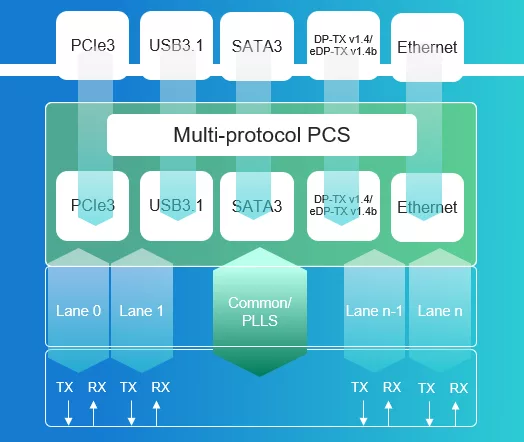
The ® IP for 10Gbps Multi-Protocol PHY simplifies the design process without compromising performance, power, or silicon die area. Crafted for mobile, wireless IoT, consumer, and automotive designs, the IP is designed for multi-protocols running on a single PHY macro and is compliant with USB 3.1, PCI Express® (PCIe®) 3.1, DisplayPort TX v1.4, Embedded DisplayPort TX v1.4b, SATA 3, 10G-KR and QSGMII/SGMII.
Key features
- Supports USB 3.1, PCIe 3.1, DP-TX v1.4/eDP-TX v1.4b, SATA 3, 10G-KR and QSGMII/SGMII
- Multi-protocol support for simultaneous independent links
- Supports SRIS and internal SSC generation
- Supports PCIe L1 sub-states
- Automatic calibration of on-chip termination resistors
- Supports internal and external clock sources with clock active detection
- SCAN, BIST, and serial/parallel loopback functions
Block Diagram
Benefits
- Multi-Protocol with Multi-Link Capability: Single PHY macro offers optimum SoC configurability with the protocol mix and match
- Optimized Performance, Power, and Area: Best fit for applications requiring performance with small footprint
- Comprehensive Test Feature Enable Rapid SoC Development: Extensive BIST and DFT enable ease of integration, faster bring-up, and quick debugging
Specifications
Identity
Standards & Interfaces
Files
Note: some files may require an NDA depending on provider policy.
Provider
Learn more about Single-Protocol PHY IP core
Rethinking AI Infrastructure: The Rise of PCIe Switches
UALink Under the Hood: Why Full-Stack Verification Wins
CES 2026 Recap: Trust Built on a Real, Working eUSB2V2 System Demo
Enhancing PCIe6.0 Performance: Flit Sequence Numbers and Selective NAK Explained
A Look at New Open Standards to Improve Reliability and Redundancy of Automotive Ethernet
Frequently asked questions about Single-Protocol PHY IP
What is USB 3.1 PHY?
USB 3.1 PHY is a Single-Protocol PHY IP core from Cadence Design Systems, Inc. listed on Semi IP Hub.
How should engineers evaluate this Single-Protocol PHY?
Engineers should review the overview, key features, supported foundries and nodes, maturity, deliverables, and provider information before shortlisting this Single-Protocol PHY IP.
Can this semiconductor IP be compared with similar products?
Yes. Buyers can compare this product with similar semiconductor IP cores or IP families based on category, provider, process options, and structured technical specifications.