Overview
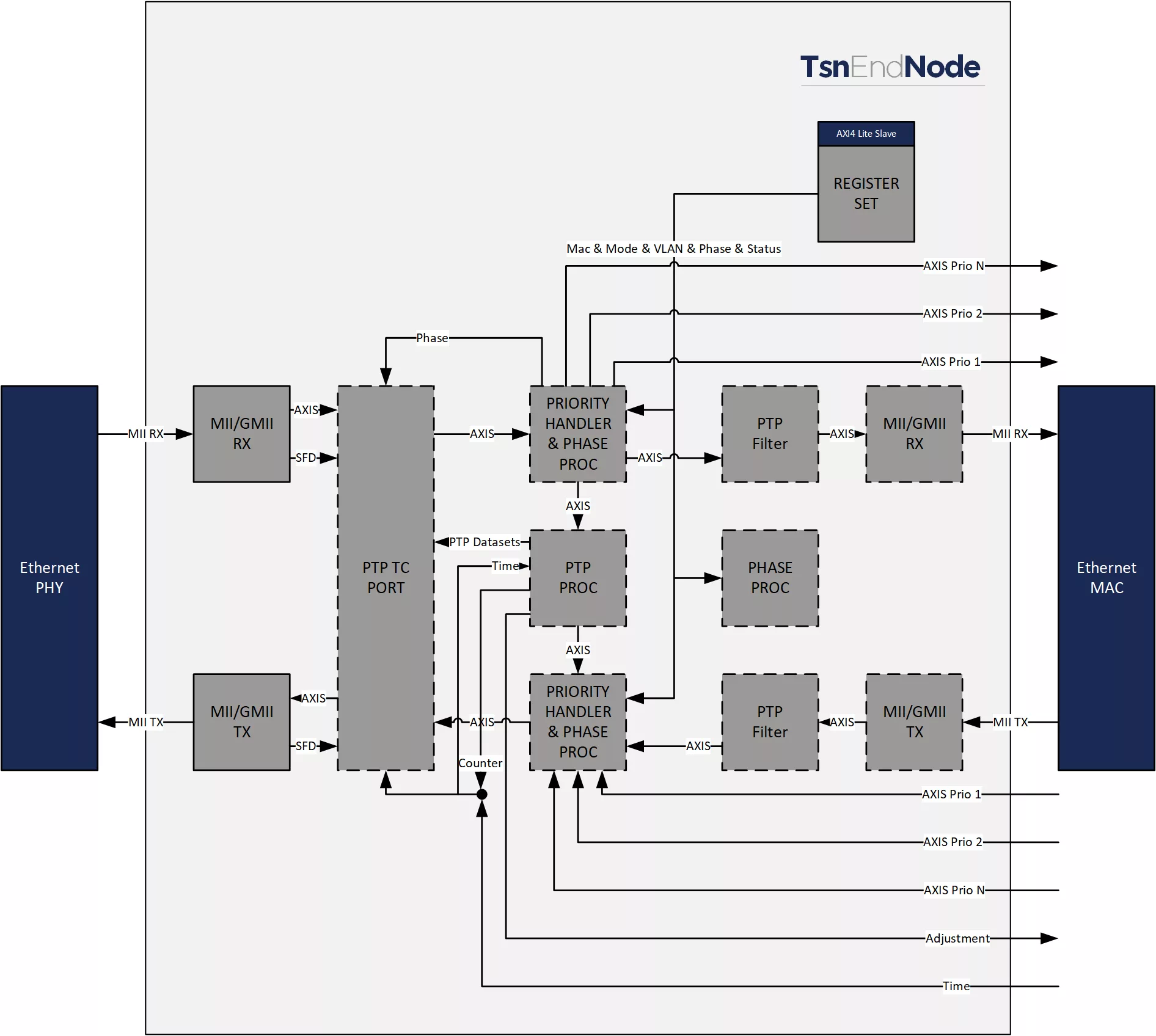
The TSN End Node IP core from NetTimeLogic is a standalone Time Sensitive Networking (TSN) single port end node core according to IEEE 802.1 and IEEE 1588 standards. It supports the same features as the TSN Network Node (switched endpoint) core except network redundancy. It is meant as a TSN co-processor enabling non-TSN aware interfaces (e.g. legacy or "normal"MAC) to support TSN features like scheduling, priority queues, credit shaping, cyclic forwarding and preemption. The core is intercepting the path between the Ethernet PHY and an Ethernet core that forwards or handles Ethernet frames (MAC, PHY or Switch). In addition, it has up to 8 streaming ports which allow to send and receive frames directly from the specific priority queues and phases.
All tables, protocols and algorithms are implemented completely in HW in the core, no CPU is required, except for configuration. This allows running TSN protocols completely independent and standalone from the user application.
Learn more about Ethernet IP core
Now place a MACsec engine between an existing MAC and PHY with new xMII bridges; handle key management with new MKA stack and drivers
Humanoid robots are moving from research demos toward real products, and the network inside them is becoming the hard problem. Single Pair Ethernet and Time-Sensitive Networking are emerging as the answer, and CAST already builds the IP cores that make it deterministic.
The evolution to centralized vehicle computing is driving new connectivity requirements. Discover how SerDes supports high-speed sensor data streaming while reducing system complexity.
Building on its High-Speed Ethernet controller IP family, Cadence provides ESUN-ready controller IP for next-generation AI scale-up networking.
This blog post explores how the team verified a 10BASE-T1S automotive ethernet subsystem using a Cadence tools-based multi-platform verification, which unifies simulation, emulation, and formal verification techniques.
Learn how ESUN enhances Ethernet for lossless, predictable AI scale-up networking—cutting overhead, reducing tail latency, and improving efficiency.