ZLG Selects CAST CAN XL and TSN IP for Next-Generation Vehicle-Network Development and Test Tools
Standards-compliant IP supports CAN XL tools and deterministic Ethernet switches for OEM R&D, production, and testing
Highly flexible, low-latency, multiport TSN Ethernet switch
The TSN-SW implements a highly flexible, low-latency, multiport TSN Ethernet switch. It supports the hardware functionality for Ethernet bridging according to the IEEE 802.1Q standard and implements the essential TSN timing synchronization and traffic-shaping protocols (i.e. IEEE 802.1AS-2020, 802.1Qav, 802.1Qbv, and 802.1Qbu, 802.1br). Enhanced reliability features can also be supported, using the optional hardware modules for Frame Replication and Elimination for Reliability (IEEE 802.1CB) and Per-Stream Filtering and Policing (IEEE 802.1Qci). Featuring a configurable number of ports, the Layer-2 switch operates in cut-through mode at wire speed and can provide sub-microsecond port-to-port latency. The core is hence suitable for applications with demanding real-time requirements.
The TSN-SW operates efficiently under different usage scenarios and is highly configurable. Users can configure key factors via the core’s control registers: the mapping of VLAN priority levels to TSN traffic classes, the traffic scheduling and preemption parameters, the treatment of special frames (i.e. broadcast, unknown, & internal), as well as the VLAN ID and MAC lookup tables used for frame forwarding and filtering. The host system can also switch the mode of operation of each individual port from cut-through to store-and-forward to eliminate the propagation of bad frames at the cost of increased latency. The core otherwise operates autonomously and only requires software assistance at runtime for correct time synchronization; a lightweight ptp/802.1AS software stack comes with the core for that purpose.
The TSN-SW uses standard AMBA® interfaces to ease integration. Its control and status registers are accessible via a 32-bit-wide APB bus, and packet data can be exchanged with the host system via AXI-Streaming interfaces with 32-bit data buses. To further expedite and ease the implementation of customer applications, DMA engines providing access to the stream interfaces via a memory-mapped AXI4 master port, and software stacks supporting higher-layer protocols, such as IEEE 802.1Qcc, IEEE 802.1Qca and SNMP, are optionally available.
The TSN-SW is designed with industry best practices and is available in synthesizable RTL (Verilog 2001) source code or as a targeted FPGA netlist. Deliverables provide everything required for a successful implementation, including sample synthesis and simulation scripts, an extensive testbench, and comprehensive documentation.
Low-Latency & Flexible Ethernet Switch
TSN Features
Easy System Integration
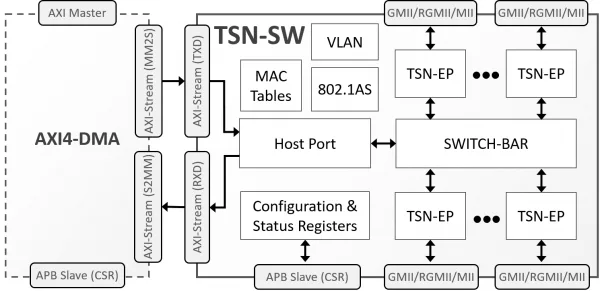
The TSN-SW is suitable for implementing TSN Ethernet End-points in daisy-chained networks (e.g. ring topologies) requiring robust, low-latency, and deterministic communication. Such networks are used in automotive, industrial control, medical, and aerospace applications.
The core includes everything required for successful implementation:
Reference FPGA designs with a freeRTOS example software stack with Command Line Interface can be made available on request.
Note: some files may require an NDA depending on provider policy.

Multiport TSN Ethernet Switch is a Ethernet IP core from CAST listed on Semi IP Hub.
Engineers should review the overview, key features, supported foundries and nodes, maturity, deliverables, and provider information before shortlisting this Ethernet IP.
Yes. Buyers can compare this product with similar semiconductor IP cores or IP families based on category, provider, process options, and structured technical specifications.