Vendor: CAST Category: Data Compression

LZ4/Snappy Data Decompressor

LZ4SNP-D is a custom hardware implementation of a lossless data decompression engine for the LZ4 and Snappy compression algorithm…

Overview

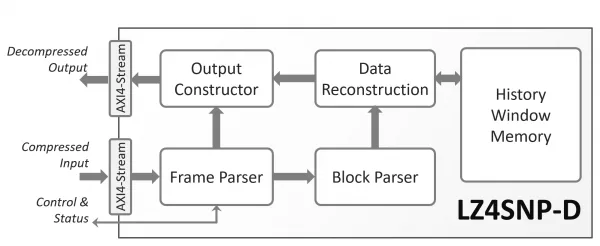
LZ4SNP-D is a custom hardware implementation of a lossless data decompression engine for the LZ4 and Snappy compression algorithms. The core receives compressed files, automatically detects the LZ4 or Snappy format, and outputs the decompressed data.

The core features fast processing with low latency and high throughput. In its default configuration, LZ4SNP-D outputs 7.8 bytes of decompressed data per clock cycle and can be clocked at frequencies exceeding 1 GHz in modern ASIC technologies. Designers can scale the throughput by instantiating the core multiple times to achieve throughput rates exceeding 100Gbps. The processing latency is approximately 30 clock cycles.

The decompression core operates on a standalone basis—offloading the host CPU from the demanding task of data decompression—and has been designed for easy integration and use. No preprocessing of the incoming compressed files is required, as the core parses the file headers, checks the input files for errors, and outputs the decompressed data payload.

Extensive error tracking and reporting enable the core to ensure smooth system operation and error recovery, even in the presence of errors in the compressed input files. Furthermore, internal memories can optionally support Error Correction Codes (ECC) to simplify achieving enterprise-class reliability or functional safety requirements.

The LZ4SNP-D core is a microcode-free design developed for reuse in ASIC and FPGA implementations. Its streaming data interface—optionally bridged to AMBA® AXI4-Stream—eases SoC integration. Technology mapping is straightforward, as the design is scan-ready, LINT-clean, microcode-free, and uses easily replaceable, generic memory models.
Key features

  • Compression Algorithms
    • LZ4
      • 64KB history window size
      • All frame and block formats
      • CRC checking (optional, on request)
      • Dictionaries not supported
    • Snappy
      • 64KB history window size
      • All frame and stream formats
      • CRC checking (optional, on request)
  • High Performance & Low Latency
    • Average processing rate of 7.8 decompressed bytes per clock cycle
    • Clock frequency in excess of 1GHz on modern ASIC processes, and more than 300MHz on high-end FPGAs
    • Latency of approximately 30 clock cycles
  • Easy to Use and Integrate
    • Processor-free, standalone operation
    • Automatic detection of input frame format (LZ4 or Snappy)
    • Extensive error catching & reporting for smooth operation and recovery in the presence of errors
      • CRC 32 errors
      • File size errors
      • Coding errors
      • Non-correctable ECC memory errors
    • Optional ECC memories
    • AXI-Stream or native FIFO-like data interfaces
    • Single clock domain design
    • Interface bridges and DMAs available separately
    • Microcode-free, LINT-clean, scan-ready design
  • Configuration Options
    • Synthesis-time configuration options allow finetuning the core’s size and performance:
      • Input and output bus widths
      • FIFO sizes
      • Maximum history window
      • Data-path width
      • More

Block Diagram

What’s Included?

  • Sophisticated Test Environment
  • Simulation scripts, test vectors, and expected results
  • Synthesis script
  • Comprehensive user documentation

Specifications

Identity

Part Number
LZ4SNP-D
Vendor
CAST
Type
Silicon IP

Files

Note: some files may require an NDA depending on provider policy.

Provider

HQ: USA

Learn more about Data Compression IP core

Evaluating Lossless Data Compression Algorithms and Cores

Data compression plays a critical role in modern computing, enabling efficient storage and faster transmission of information. Among lossless data compression algorithms, GZIP, ZSTD, LZ4, and Snappy have emerged as prominent contenders, each offering unique trade-offs in terms of compression ratio, speed, and resource utilization. This white paper evaluates these algorithms and their corresponding hardware cores, providing an in-depth comparison to help developers and system architects choose the optimal solution for their specific use case.

Firmware Compression for Lower Energy and Faster Boot in IoT Devices

The phrase “IoT” for Internet of Things has exploded to cover a wide range of different applications and diverse devices with very different requirements. Most observers, however, would agree that low energy consumption is a key element for IoT, as many of these devices must run on batteries or harvest energy from the environment.

Understanding - and Reducing - Latency in Video Compression Systems

In the video world, latency is the amount of time between the instant a frame is captured and the instant that frame is displayed. Low latency is a design goal for any system where there is real-time interaction with the video content, such as video conferencing or drone piloting. But the meaning of “low latency” can vary, and the methods for achieving low latency aren’t always obvious. Here we’ll define and explain the basics of video latency, and discuss how one of the biggest impacts in reducing latency comes from choosing the right video encoding.

Understanding - and Reducing - Latency in Video Compression Systems

In the video world, latency is the amount of time between the instant a frame is captured and the instant that frame is displayed. Low latency is a design goal for any system where there is real-time interaction with the video content, such as video conferencing or drone piloting.

Frequently asked questions about Data Compression IP

What is LZ4/Snappy Data Decompressor?

LZ4/Snappy Data Decompressor is a Data Compression IP core from CAST listed on Semi IP Hub.

How should engineers evaluate this Data Compression?

Engineers should review the overview, key features, supported foundries and nodes, maturity, deliverables, and provider information before shortlisting this Data Compression IP.

Can this semiconductor IP be compared with similar products?

Yes. Buyers can compare this product with similar semiconductor IP cores or IP families based on category, provider, process options, and structured technical specifications.

×
Semiconductor IP