Overview
The LPDDR6 PHY IP is a high-speed, low-power physical layer interface IP designed for next-generation mobile memory, automotive applications, and high-bandwidth SoCs requiring power-efficient memory connectivity. It complies with the latest LPDDR6 standard and supports high-speed data transfer rates with advanced signal integrity and power management features.
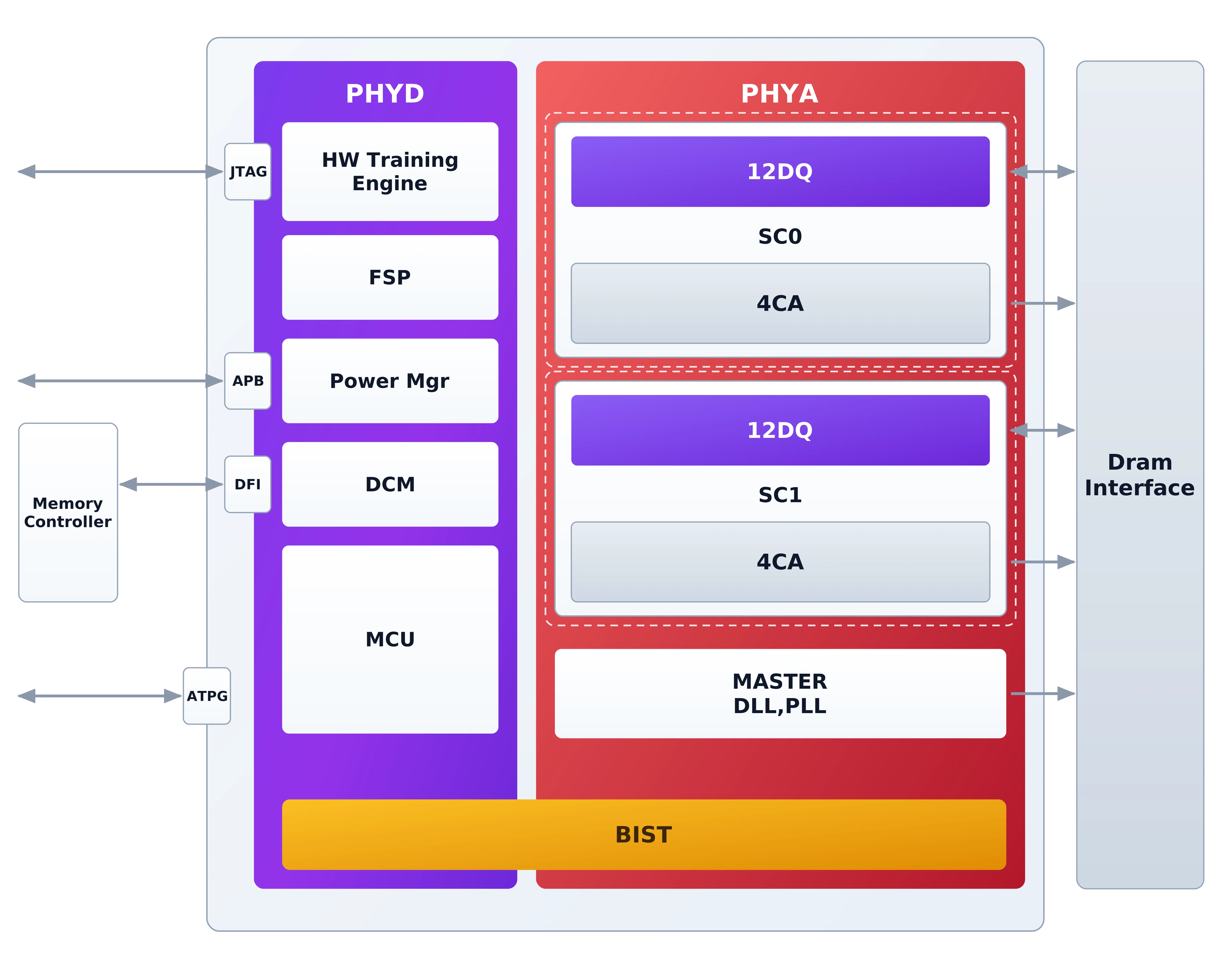
MSquare' LPDDR6 IP is a transceiver IP between DRAM controller and DRAM device. Supporting DFI5.1 as a universal IP protocol. The maximum data rate of LPDDR6, LPDDR5X, LPDDR5 and LPDDR4X can reach 14400Mbps, 8533Mbps, 6400Mbps and 4266Mbps respectively with 16bit data width per channel. Figure 1 is LPDDR6 PHY block diagram in system application, which includes Data, Address transmit path, Receiver data path and PLL block, etc.
Learn more about LPDDR IP core
JEDEC has just released the LPDDR6 specification that is expected to take the LPDDR DRAM market to new heights with data transfer speeds that can reach up to 14.4Gbps, which is a 50% improvement over LPDDR5X speeds. LPDDR6 device density can range from 4 GB to 64 GB.
This solution brief highlights how Samsung’s mainstream 8nm process node and LPDDR5X (LP5X) memory together deliver an optimized balance of performance, bandwidth, power efficiency, and cost. The combination enables scalable AI inference across diverse computing environments, from edge devices and AI appliances to emerging inference-focused AI infrastructure, making advanced AI deployment more accessible for startups, fabless innovators, and OEMs alike.
Next-generation automotive systems are advancing beyond the limits of currently available technologies. The addition of advanced driver assistance systems (ADAS) and other advanced features requires greater processing power and increased connectivity throughout the vehicle.
The authors co-design WIFiV-LPDDR, a wide-I/O LPDDR system for precision-tagged reads, BRQ-KV for a canonical low-rank-plus-INT8-residual prefix with query-dependent per-entry precision, and DAT-FFN for drift-mapped canonical replacement, adjacent-stage-corrected low-bit delta, or cached-state carry while keeping live activations unquantized.