Ultra Ethernet's Design Principles and Architectural Innovations
By Torsten Hoefler 1,2, Karen Schramm 3, Eric Spada 3, Keith Underwood 4, Cedell Alexander 3, Bob Alverson 4, Paul Bottorff 4, Adrian Caulfield 5, Mark Handley 5, Cathy Huang 6, Costin Raiciu 3, Abdul Kabbani 7, Eugene Opsasnick 3, Rong Pan 8, Adee Ran 9, Rip Sohan 8
1 ETH Zurich, Switzerland
2 Microsoft, USA
3 Broadcom,USA
4 Hewlett Packard Enterprise, USA
5 OpenAI,USA
6 Intel,USA
7 Microsoft, USA
8 AMD,USA
9 Cisco, USA
Abstract
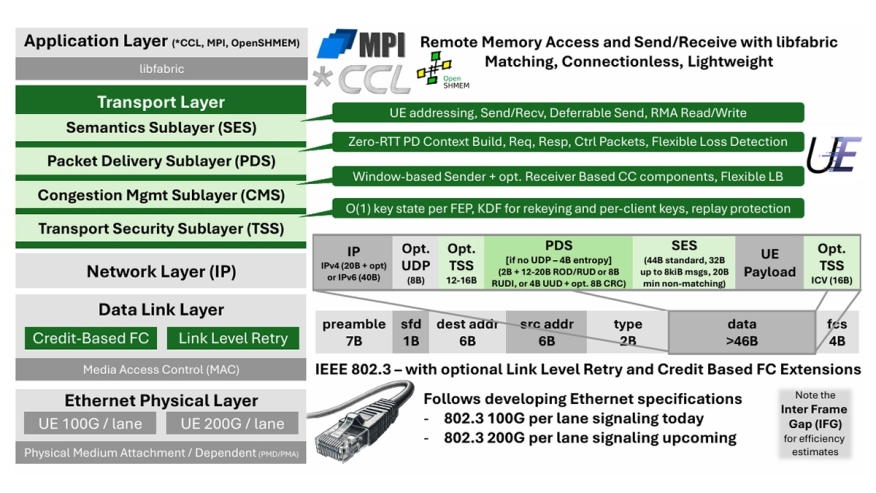
The recently released Ultra Ethernet (UE) 1.0 specification defines a transformative High-Performance Ethernet standard for future Artificial Intelligence (AI) and High-Performance Computing (HPC) systems. This paper, written by the specification's authors, provides a high-level overview of UE's design, offering crucial motivations and scientific context to understand its innovations. While UE introduces advancements across the entire Ethernet stack, its standout contribution is the novel Ultra Ethernet Transport (UET), a potentially fully hardware-accelerated protocol engineered for reliable, fast, and efficient communication in extreme-scale systems. Unlike InfiniBand, the last major standardization effort in high-performance networking over two decades ago, UE leverages the expansive Ethernet ecosystem and the 1,000x gains in computational efficiency per moved bit to deliver a new era of high-performance networking.
To read the full article, click here
Related Semiconductor IP
- 1.6T Ultra Ethernet Controller
- Ultra Ethernet MAC & PCS 100G/200G/400G/800G
- Ultra Ethernet Verification IP
- Verification IP for Ultra Ethernet (UEC)
- 100G MAC/PCS Ultra Ethernet
Related Articles
- Convey UHD 4K Video over 1Gbit Ethernet with the intoPIX JPEG 2000 "Ultra Low Latency" compression profile
- How Ultra Ethernet And UALink Enable High-Performance, Scalable AI Networks
- Opto-electronics -> Architectural synthesis provides flexibilty in optical network design
- 10-Gbit Ethernet revenues to reach $3.6 billion by '04, says Dataquest
Latest Articles
- Terracotta: Enabling the Adoption of New DRAM Techniques via a Flexible DRAM Interface and Memory Controller
- A Framework for Accelerating Transformer Inference on RISC-V for Edge AI
- An Interleaved Parallel Dependent Quantization Hardware Architecture for H.266/VVC
- A Formal Security Analysis of CAN XL
- A Secure dToF LiDAR SoC with Dual-Domain Fingerprinting and Event-Driven AFE Circuit Achieving Sensor-Level Attack Resilience