QMC: Efficient SLM Edge Inference via Outlier-Aware Quantization and Emergent Memories Co-Design
By Nilesh Prasad Pandey 1, Jangseon Park 1, Onat Gungor 1, Flavio Ponzina 2, Tajana Rosing 1
1 University of California San Diego
2 San Diego State University
Abstract
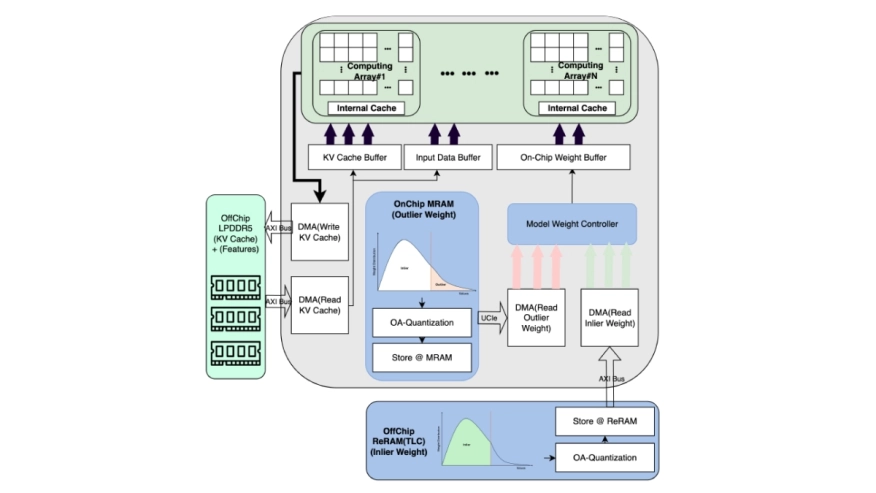
Deploying Small Language Models (SLMs) on edge platforms is critical for real-time, privacy-sensitive generative AI, yet constrained by memory, latency, and energy budgets. Quantization reduces model size and cost but suffers from device noise in emerging non-volatile memories, while conventional memory hierarchies further limit efficiency. SRAM provides fast access but has low density, DRAM must simultaneously accommodate static weights and dynamic KV caches, which creates bandwidth contention, and Flash, although dense, is primarily used for initialization and remains inactive during inference. These limitations highlight the need for hybrid memory organizations tailored to LLM inference. We propose Outlier-aware Quantization with Memory Co-design (QMC), a retraining-free quantization with a novel heterogeneous memory architecture. QMC identifies inlier and outlier weights in SLMs, storing inlier weights in compact multi-level Resistive-RAM (ReRAM) while preserving critical outliers in high-precision on-chip Magnetoresistive-RAM (MRAM), mitigating noise-induced degradation. On language modeling and reasoning benchmarks, QMC outperforms and matches state-of-the-art quantization methods using advanced algorithms and hybrid data formats, while achieving greater compression under both algorithm-only evaluation and realistic deployment settings. Specifically, compared against SoTA quantization methods on the latest edge AI platform, QMC reduces memory usage by 6.3x-7.3x, external data transfers by 7.6x, energy by 11.7x, and latency by 12.5x when compared to FP16, establishing QMC as a scalable, deployment-ready co-design for efficient on-device inference.
To read the full article, click here
Related Semiconductor IP
- nQrux® Root of Trust IP
- AXI to UCIe Bridge IP
- UCIe 2.x Controller IP
- SWI3S (SoundWire I3S Interface) Peripheral Controller Core IP
- OpenTitan-based RISC-V Secure Element
Related Articles
- Pyramid Vector Quantization and Bit Level Sparsity in Weights for Efficient Neural Networks Inference
- FPGA-Accelerated RISC-V ISA Extensions for Efficient Neural Network Inference on Edge Devices
- VitaLLM: A Versatile and Tiny Accelerator for Mixed-Precision LLM Inference on Edge Devices
- An efficient way of loading data packets and checking data integrity of memories in SoC verification environment
Latest Articles
- Automated Pre-Silicon Verification of High-Speed DDR5 and LPDDR5/6 Memory Controllers: Closed-Loop Timing, Mode Register, and PHY Synchronization in UVM
- U-Sonic: An Open-Source 8-Channel Ultrasound Transmit IP in a 130 nm RISC-V SoC
- S-ALSA: Co-Design of Adiabatic Logic-based Sensing and Balanced Bit-Cells for Secure and Energy-Efficient MRAM
- MEGATRON: a 28nm Analog PCM CiM/Digital System-on-Chip for Edge GenAI at 57.5 TOPS/W and 1.52 Mparam/mm²
- Peregrino: A Full-Hardware Accelerator for the Complete Falcon Post-Quantum Digital Signature Scheme on Resource-Constrained Edge Devices