PDF: PUF-based DNN Fingerprinting for Knowledge Distillation Traceability
By Ning Lyu, Yuntao Liu, Yonghong Bai, Zhiyuan Yan
Abstract
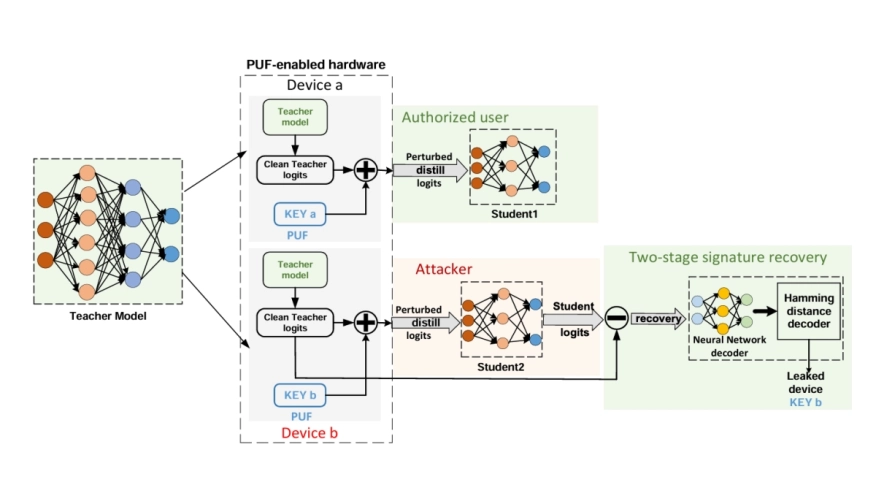
Knowledge distillation transfers large teacher models to compact student models, enabling deployment on resource-limited platforms while suffering minimal performance degradation. However, this paradigm could lead to various security risks, especially model theft. Existing defenses against model theft, such as watermarking and secure enclaves, focus primarily on identity authentication and incur significant resource costs. Aiming to provide post-theft accountability and traceability, we propose a novel fingerprinting framework that superimposes device-specific Physical Unclonable Function (PUF) signatures onto teacher logits during distillation. Compared with watermarking or secure enclaves, our approach is lightweight, requires no architectural changes, and enables traceability of any leaked or cloned model. Since the signatures are based on PUFs, this framework is robust against reverse engineering and tampering attacks. In this framework, the signature recovery process consists of two stages: first a neural network-based decoder and then a Hamming distance decoder. Furthermore, we also propose a bit compression scheme to support a large number of devices. Experiment results demonstrate that our framework achieves high key recovery rate and negligible accuracy loss while allowing a tunable trade-off between these two key metrics. These results show that the proposed framework is a practical and robust solution for protecting distilled models.
Keywords: Knowledge Distillation, Model Fingerprinting, Physical Unclonable Function (PUF), Neural Network Security, Edge AI
To read the full article, click here
Related Semiconductor IP
- UALink 200G v1.0 Verification IP
- CCSDS SCCC Demapper and Turbo Decoder
- NPU IP
- JPEG XL Encoder
- I2C Master/Slave Controller Core
Related Articles
- Using OVM to reuse vital verification knowledge
- DO-254 Requirements Traceability
- A Knowledge Sharing Framework for Fabs, SoC Design Houses and IP Vendors
- Standardized PUF-based Solution for Device eID
Latest Articles
- Anechoic: Onsager-Corrected Parallel Annealing for Sub-0.1 ms Dense Max-Cut on an FPGA
- Power, Performance, and Area of HPC-Based Malware Detectors: An FPGA and Open-PDK ASIC Study
- Terracotta: Enabling the Adoption of New DRAM Techniques via a Flexible DRAM Interface and Memory Controller
- A Framework for Accelerating Transformer Inference on RISC-V for Edge AI
- An Interleaved Parallel Dependent Quantization Hardware Architecture for H.266/VVC