Minimum RISC-V: Maximum FPGA Efficiency
By Martin Langhammer, Bogdan Pasca, Gregg Baeckler
Altera
Abstract
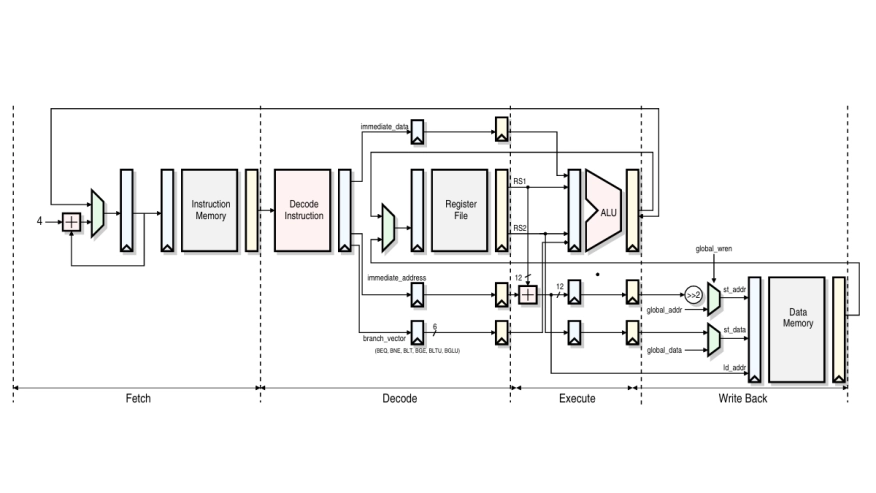
RISC-V processors are now widely available for FPGAs, with most FPGA vendors replacing their proprietary soft-CPU architectures with this instruction-set architecture (ISA). Although contemporary FPGAs are increasingly resource- and feature-rich, a soft processor system---including memory---often occupies a disproportionately large footprint and delivers only modest performance relative to the potential of the target device. In this work we first design a lightweight but deeply pipelined RISC-V core that can run above 700 MHz in a mid-range device and that is capable of retiring one instruction per clock under ideal conditions. We then develop and demonstrate a new optimization method that compiles the final application binary and a specialized processor instance contemporaneously. The method expands each instruction into an application-specific encoding, removes unused datapath and decode logic during synthesis, and yields cores that remain assembler-compatible with the original program while no longer being binary-compatible with a general-purpose RISC-V. We implement example designs on RV32I (base integer), RV32M (integer multiply), and RV32F (single-precision floating-point) configurations. Our optimized RISC-V is as small as 170 ALMs and closes timing at 775 MHz in an Altera Agilex-5 device. Finally, we show that these processors can be packed into a deterministic area and stepped-and-repeated continuously without material impact on performance, enabling predictable multi-core density planning.
Keywords: FPGA, RISC-V, soft processor, application-specific processor, high-frequency design, synthesis.
To read the full article, click here
Related Semiconductor IP
- RISC-V Debug & Trace IP
- RISC-V IOPMP IP
- Gen#2 of 64-bit RISC-V core with out-of-order pipeline based complex
- 64-bit RISC-V core with in-order single issue pipeline. Tiny Linux-capable processor for IoT applications.
- Multi-core capable RISC-V processor with vector extensions
Related Articles
- Achieving maximum motor efficiency using dual core ARM SoC FPGAs
- Optimizing Energy Efficiency in Subthreshold RISC-V Cores
- Ramping Up Open-Source RISC-V Cores: Assessing the Energy Efficiency of Superscalar, Out-of-Order Execution
- Retention-Aware RISC-V ISA Extension and Memory Controller on FPGA for MLC NVM
Latest Articles
- Minimum RISC-V: Maximum FPGA Efficiency
- The Era of Vibe Tapeout: Dark Age or Golden Age for Analog Circuit Design?
- Understanding the Power Consumption of Modern High Bandwidth Memory: Experimental Analysis and Modeling Using Real HBM2 DRAM Chips
- BARE-AI: Bit-Flip Attack Resilience in AI Hardware through Built-in Performance Monitors
- RFChipAgent: Multi-Agentic AI Flow for Analog/RF Chip Design