Clock Distribution Network with Backside Clock Mesh in BSPDN Architecture
By Seohyun Kim, Youngjin Chae, Shilong Zhang, Youngsoo Shin
Korea Advanced Institute of Science and Technology (KAIST), Republic of Korea
Abstract
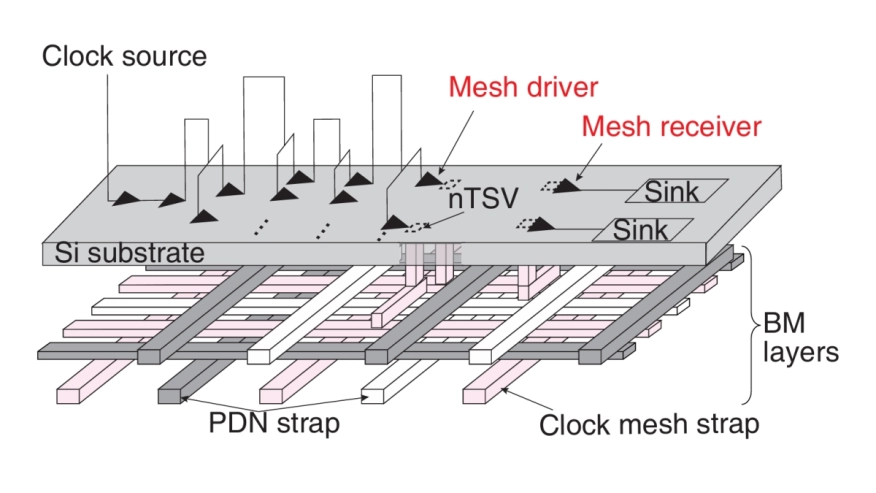
We propose a clock distribution network (CDN) in which the clock mesh is located on backside metal (BM) layers, while the rest of the network remains on the frontside. Since the backside power distribution network (BSPDN) also uses the BM layers, the clock mesh and power network must share them. We identify an important problem of placing mesh receivers while accounting for keep-out zones (KOZs) between clock- and power-nTSVs. We show that this problem can be solved using a potential-field method (PFM).
Machine learning models are developed to place the mesh receivers: a U-Net predicts their initial positions, and an MLP predicts force weights for PFM-guided position refinement. Both models are trained through self-supervised learning by optimizing a differentiable objective that accounts for clock latency, IR-drop, and KOZ violations. Experimental results show that, on average, the proposed CDN reduces maximum local clock latency by 26%, global clock skew by 40%, and mesh switching power by 29% compared with a frontside CDN. On the same backside CDN, ML-guided PFM satisfies KOZ constraints while lowering IR-drop by 33% and requiring 85% fewer iterations than standard PFM.
Keywords: Backside clock mesh, mesh receiver placement, machine learning
To read the full article, click here
Related Semiconductor IP
- Source-synchronous die-to-die interface
- Parametric System-on-Chiplet IP core
- Parametric active-interposer IP core
- Parametric 64-bit dual-issue in-order processor
- Low-latency 2D mesh network-on-chip (NoC) IP core
Related Articles
- Clock Mesh Variation Robustness: Benefits and Analysis
- Free I/O: Improving FPGA clock distribution control
- Optimizing clock tree distribution in SoCs with multiple clock sinks
- A Novel Mesh Architecture for On-Chip Networks
Latest Articles
- Clock Distribution Network with Backside Clock Mesh in BSPDN Architecture
- ReLay: Bidirectional Layout-Code Translation and Library Evolution for Reusable and Process-Portable Analog Design
- 3D-NAND-CIM: A Hybrid-Bonded 3D-NAND-Flash-based Analog In-Memory-Compute macro offering 4.8M weights/mm²
- Verify the Verifier: Specification-Grounded LLM Cross-Checking for Bugs That Escape UVM Scoreboards
- PULSAR-V: I/O-Aware Post-Update Attestation for RISC-V