LUTstructions: Self-loading FPGA-based Reconfigurable Instructions
By Philippos Papaphilippou, University of Southampton
Abstract
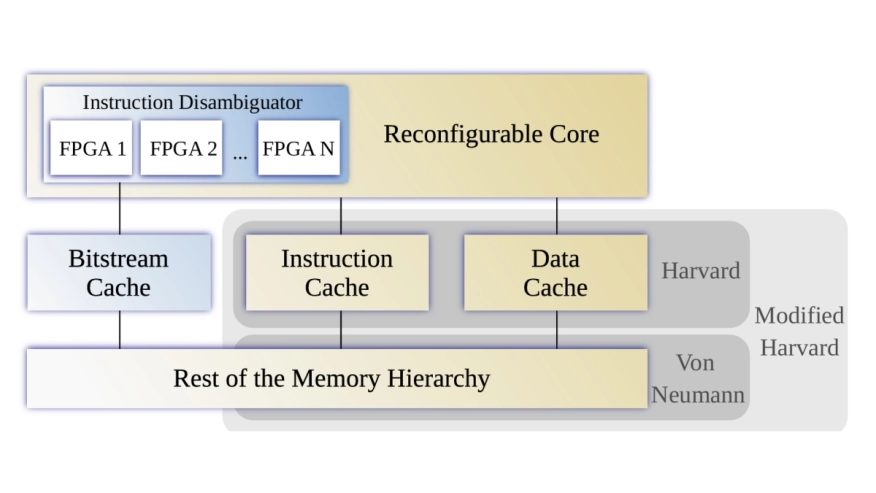
General-purpose processors feature a limited number of instructions based on an instruction set. They can be numerous, such as with vector extensions that include hundreds or thousands of instructions, but this comes at a cost; they are often unable to express arbitrary tasks efficiently. This paper explores the concept of having reconfigurable instructions by incorporating reconfigurable areas in a softcore. It follows a relatively-recently proposed computer architecture concept for seamlessly loading instruction implementation-carrying bitstreams from main memory. The resulting softcore is entirely evaluated on an FPGA, essentially having an FPGA-on-an-FPGA for the instruction implementations, with no notable operating frequency overhead. This is achieved with a custom FPGA architecture called LUTstruction, which is tailored towards low-latency for custom instructions and wide reconfiguration, as well as a soft implementation for the purposes of architectural exploration.
Keywords: FPGA, reconfigurable instructions, custom instruction, RISC-V, bit stream cache, soft instruction, eFPGA, virtual FPGA
To read the full article, click here
Related Semiconductor IP
- 64-Bit 8-stage superscalar RISC-V processor
- Multi-core capable RISC-V processor with vector extensions
- 32 Bit - Embedded RISC-V Processor Core
- ARC-V RHX-100 dual-issue, 32-bit single-core RISC-V processor for real-time applications
- ARC-V RMX-100 ultra-low power 32-bit RISC-V processor for embedded applications
Related Articles
- Reconfiguring Design -> Reconfigurable computing aims at signal processing
- Reconfigurable signal processing key in base station design
- High-Performance DSPs -> Reconfigurable coprocessors create flexibility in DSP apps
- High-Performance DSPs -> Reconfigurable approach supersedes VLIW/ superscalar
Latest Articles
- Automated Pre-Silicon Verification of High-Speed DDR5 and LPDDR5/6 Memory Controllers: Closed-Loop Timing, Mode Register, and PHY Synchronization in UVM
- U-Sonic: An Open-Source 8-Channel Ultrasound Transmit IP in a 130 nm RISC-V SoC
- S-ALSA: Co-Design of Adiabatic Logic-based Sensing and Balanced Bit-Cells for Secure and Energy-Efficient MRAM
- MEGATRON: a 28nm Analog PCM CiM/Digital System-on-Chip for Edge GenAI at 57.5 TOPS/W and 1.52 Mparam/mm²
- Peregrino: A Full-Hardware Accelerator for the Complete Falcon Post-Quantum Digital Signature Scheme on Resource-Constrained Edge Devices