An Interleaved Parallel Dependent Quantization Hardware Architecture for H.266/VVC
By Jun Zhang, Weizhi Bian, Hao Zhang
School of Automation, Central South University, Changsha 410083, China
Abstract
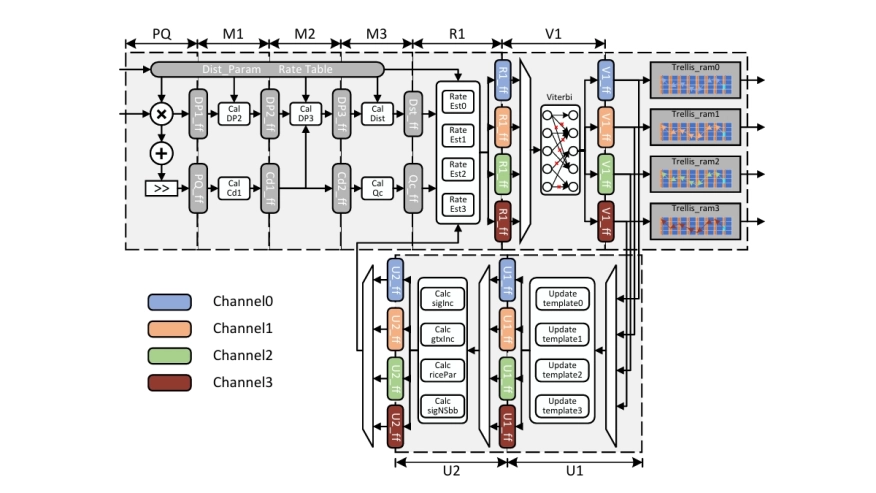
While dependent quantization in H.266/VVC delivers a high compression ratio, its strong serial nature and high complexity result in poor real-time performance, making it difficult to deploy in practical scenarios. To improve the real-time performance of dependent quantization with minimal degradation to its compression performance, we propose a interleaved parallel dependent quantization hardware architecture with low BDBR loss, which achieves four-channel parallel dependent quantization by time-division multiplexing most combinational logic. This architecture adopts the proposed intra-CG context simplification scheme and the encoding scheme that skips decAbslevel during rate estimation. The proposed design incurs a BDBR loss of only 0.42% under the All Intra configuration and 0.38% under the Random Access configuration, respectively. Implemented in Verilog HDL, the dependent quantization hardware architecture achieves quantization speeds of 4K@33.2, 91.4, 331.2, and 454.1 fps at QP = 22, 27, 32, and 37, respectively, when implemented on the Xilinx XCZU19 FPGA. When implemented on ASIC using the TSMC 28nm process standard cell library, the corresponding quantization speeds reach 4K@84.0, 231.0, 837.0, and 1147.7 fps.
Index Terms — H.266/VVC, Dependent Quantization, Hardware Architecture, Interleaved-Parallel.
To read the full article, click here
Related Semiconductor IP
- Video Processing Unit (VPU) IP
- Multi-format, multi-stream hardware Decoder for AV2
- 4K/8K Multiformat IP supporting AV2 decoder
- DeWarp IP
- High-Perfomance, multi-format Video Encoder IP
Related Articles
- A Low Complexity Parallel Architecture of Turbo Decoder Based on QPP Interleaver for 3GPP-LTE/LTE-A
- The Power of Developing Hardware and Software in Parallel
- Hybrid Hardware Architecture for Low Complexity Motion Estimation Algorithm
- LLM Inference on IMC-NoC Architecture with Balanced Dataflow and Fine-Grained Parallelism
Latest Articles
- A Framework for Accelerating Transformer Inference on RISC-V for Edge AI
- An Interleaved Parallel Dependent Quantization Hardware Architecture for H.266/VVC
- A Formal Security Analysis of CAN XL
- A Secure dToF LiDAR SoC with Dual-Domain Fingerprinting and Event-Driven AFE Circuit Achieving Sensor-Level Attack Resilience
- ZTA-Q: an Open-source RISC-V Platform for Accurate Quantized CNN Inference