Hardware-Software Co-Design for Float16 On-Device Training on RISC-V Single-Core
By Benjamin Hubinet 1,2, Pierre-Alain Moëllic 1,2, Olivier Savry 2, Olivier Potin 3, Jean-Baptiste Rigaud 3
1 CEA-Leti, Mines Saint-Etienne, Equipe Commune SAS, F-13541 Gardanne, France
2 Univ. Grenoble Alpes, CEA-Leti, F-38000 Grenoble, France
3 Mines Saint-Etienne, CEA-Leti, Centre CMP, Equipe commune SAS, F-13541 Gardanne, France
Abstract
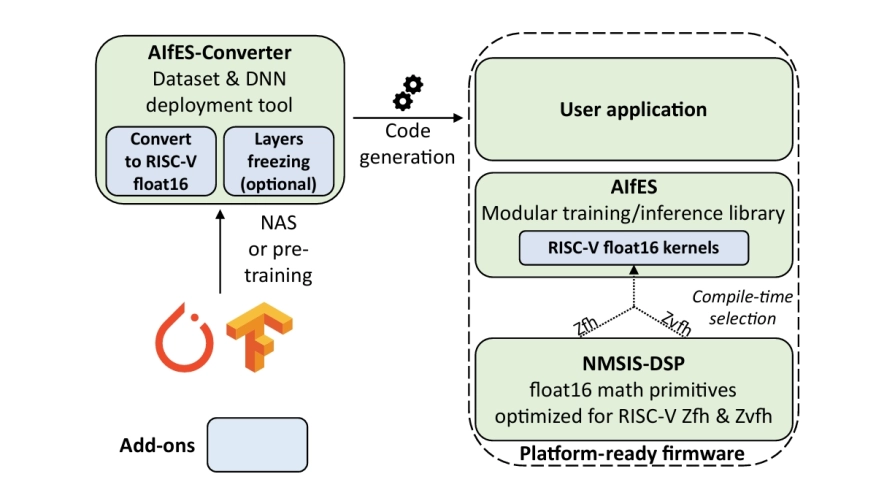
By leveraging standard RISC-V extensions, namely Zfh (scalar float16) and Zvfh (vector float16), this work proposes an open-source framework to enable complete on-device training on resource-constrained RISC-V single-core. Our approach allows memory footprint reduction by about 50% as compared to using float32 and with minimal model performance degradation. We also facilitate transfer learning and fine-tuning scenarios by incorporating layer-freezing capabilities. Our work builds onto AIfES, an open-source, modular and generic DNN training and inference framework for embedded systems that can be extended with custom hardware-specific functions. The benefits of float16 is further emphasized by outlining the low area overhead of Zfh on a RV64GC super-scalar out-of-order FPGA softcore (+1.15% LUT6 and +0.05% FF at 175MHz). Finally, we discuss the architecture of a Zvfh implementation within the same RISC-V core.
Keywords: On-Device Training, Half-Precision Floating-Point, RISC-V, Deep Neural Networks, Resource-Constrained Devices, FPGA.
To read the full article, click here
Related Semiconductor IP
- RISC-V Debug & Trace IP
- RISC-V IOPMP IP
- Gen#2 of 64-bit RISC-V core with out-of-order pipeline based complex
- 64-bit RISC-V core with in-order single issue pipeline. Tiny Linux-capable processor for IoT applications.
- Multi-core capable RISC-V processor with vector extensions
Related Articles
- HSCO-Bench: An Agent-Driven End-to-End Hardware-Software Co-design Benchmark for Systems-on-Chip
- CHIA: An open-source framework for principled, agentic AI-driven hardware/software co-design research
- Retention-Aware RISC-V ISA Extension and Memory Controller on FPGA for MLC NVM
- A Framework for Accelerating Transformer Inference on RISC-V for Edge AI
Latest Articles
- Automated Multi-Line Bug Repair Using Model Checker Aided LLMs: A Case Study on RISC-V Processors
- Cryogenic Recharacterization of a Commercial 22 nm FD-SOI Foundry Standard-Cell Library
- A 105 MS/s 4.18 nJ/inference 0.765 mm² Mixed-Signal Streaming ML Engine for Wireless Baseband in 12LP+ FinFET
- Agentic AI for Heterogeneous System Design Across Chip, Scale-Up, and Scale-Out Domains
- Minimum RISC-V: Maximum FPGA Efficiency