CVA6-RT: an Open-Source Time-Predictable RV64 Processor for Mixed-Criticality Systems
By Enrico Zelioli 1, Christopher Reinwardt 1, Nils Wistoff 1, Robert Balas 1, Alessandro Ottaviano 3, Luca Benini 1,2, Angelo Garofalo 1,2
1 Integrated Systems Laboratory, ETH Zurich
2 Department of Electrical, Electronic, and Information Engineering, University of Bologna
3 Tenstorrent
Abstract
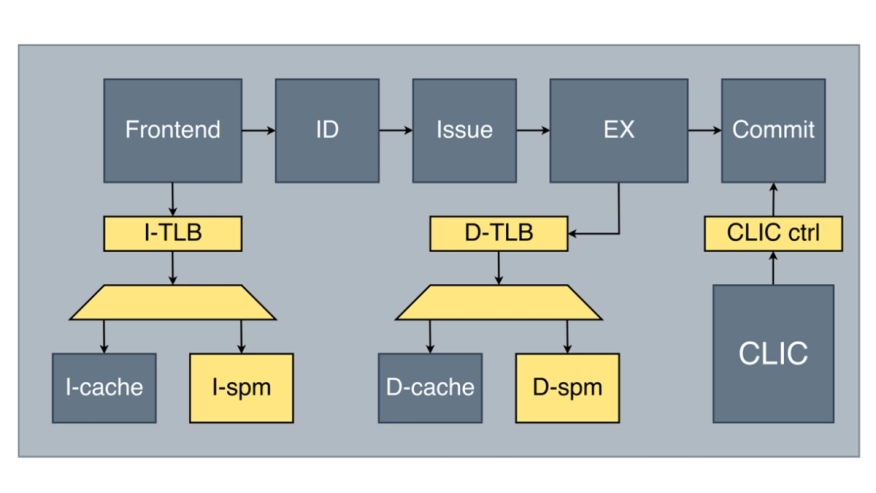
This work presents CVA6-RT, a real-time micro-architectural extension of the CVA6 core to bound worst-case latency and reduce task's timing execution variability. CVA6-RT implements the rv64gch ISA and features advanced support for real-time execution, including TLB partitioning and locking for predictable address translation, a dynamically reconfigurable scratchpad mode in the L1 caches for deterministic memory access, and low-latency interrupt handling via an enhanced interrupt controller combined with hardware-assisted context stacking. With real-time features enabled, CVA6-RT achieves an interrupt latency of 12 cycles, comparable to that of simpler Arm Cortex-M microcontrollers, and 10x lower than the baseline CVA6 core.
To read the full article, click here
Related Semiconductor IP
- RISC-V Debug & Trace IP
- RISC-V IOPMP IP
- Gen#2 of 64-bit RISC-V core with out-of-order pipeline based complex
- 64-bit RISC-V core with in-order single issue pipeline. Tiny Linux-capable processor for IoT applications.
- Multi-core capable RISC-V processor with vector extensions
Related Articles
- MultiVic: A Time-Predictable RISC-V Multi-Core Processor Optimized for Neural Network Inference
- Open-source cores provide new paths to SoCs
- How to optimize programmability and speed in network processor design
- SoC silicon is first-time success following simulation and validation of novel array processor
Latest Articles
- Minimum RISC-V: Maximum FPGA Efficiency
- The Era of Vibe Tapeout: Dark Age or Golden Age for Analog Circuit Design?
- Understanding the Power Consumption of Modern High Bandwidth Memory: Experimental Analysis and Modeling Using Real HBM2 DRAM Chips
- BARE-AI: Bit-Flip Attack Resilience in AI Hardware through Built-in Performance Monitors
- RFChipAgent: Multi-Agentic AI Flow for Analog/RF Chip Design