Vendor: Zero ASIC Category: Network-On-Chip

Low-latency 2D mesh network-on-chip (NoC) IP core

Open protocol • Scalable • Wide • Silicon heritage

Overview

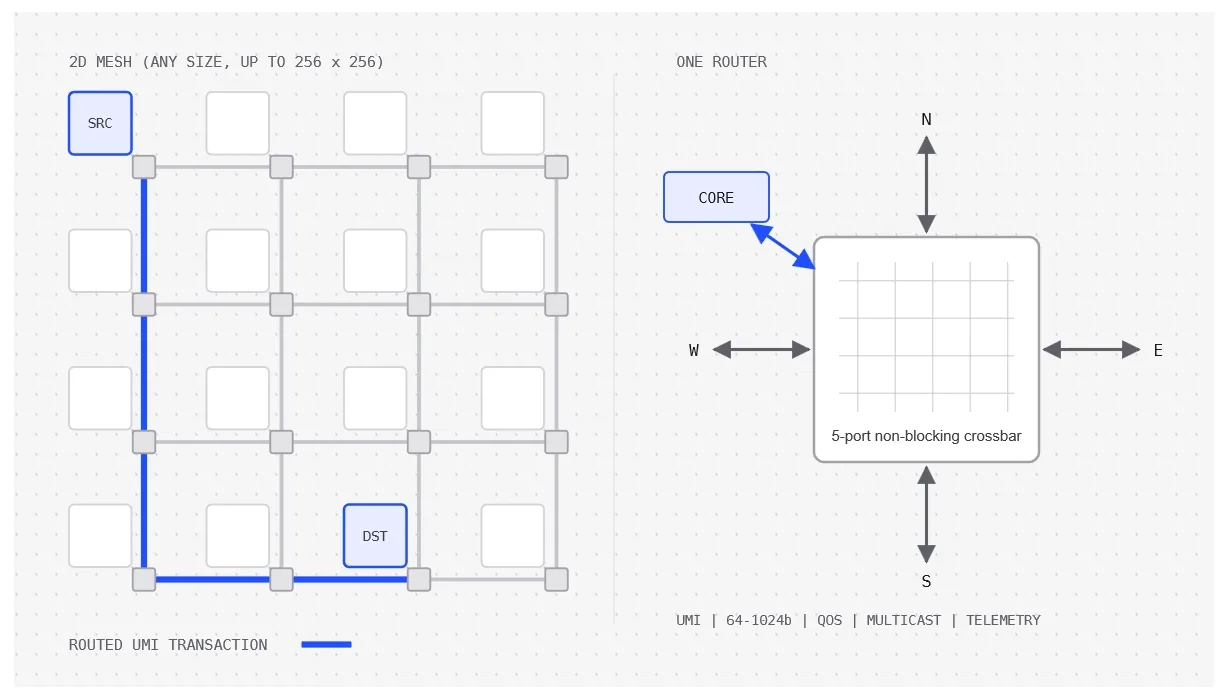
The Epiphany NoC core is a low-latency 2D mesh network-on-chip (NoC) IP core. Each router connects directly to its north, east, south and west neighbors and to a local core or device through a non-blocking crossbar, and routes UMI transactions across a grid of up to 256 x 256 nodes.

Core Summary

Feature Epiphany NoC
Protocol UMI, including atomic transactions
Topology 2D mesh, up to 256 x 256 nodes
Routing deterministic, ultra-low-latency XY routing
Multicast hardware multicast, one packet reaches every node with no duplicates
Data width 64 to 1024-bit
Address width 32 or 64-bit
Networks physically separate request and response networks
Quality of service multi-level priority
Telemetry network traffic telemetry
Security built-in firewall

I/O Bandwidth

Per router link, per direction.

Data width (bits) 1 GHz (Gbps) 2 GHz (Gbps)
64 64 128
128 128 256
256 256 512
512 512 1,024
1024 1,024 2,048

Development Tools

Category Content
Build Automation SiliconCompiler Python-driven build system
Emulation Switchboard system emulation

IP Deliverables

Deliverable File format
Datasheet PDF, HTML
Integration Guide PDF, HTML
RTL Verilog
Timing constraints SDC
Testbench Verilog
Build scripts SiliconCompiler (Python)

Heritage

The Epiphany mesh network has been proven in silicon across several generations of Epiphany processors, up to the 1,024-core Epiphany-V.

Access Model

The Epiphany NoC core is available via commercial IP agreements. Contact our team to learn more about licensing terms and availability.


Key features

  • Open protocol: built on the open Universal Memory Interface (UMI) transaction layer
  • Scalable: one router design for any grid size, from a few tiles to 65,536 nodes
  • Wide: 64-bit to 1024-bit datapath, selected at build time
  • Managed: quality of service, telemetry, security and power control built into every router
  • Silicon heritage: the Epiphany mesh network has shipped in five generations of Epiphany processor tapeouts (16nm, 28nm, and 65nm).

Block Diagram

Applications

  • AI and machine learning accelerators: tensor and systolic arrays
  • Many-core processors for HPC and supercomputing
  • Radar, phased-array and 5G/6G baseband signal processing
  • Spatial dataflow and coarse-grained reconfigurable arrays (CGRAs)
  • Network and packet processing
  • Automotive and robotics sensor fusion
  • Large SoCs with many hosts and memories

Specifications

Identity

Part Number
Epiphany NoC
Vendor
Zero ASIC
Type
Silicon IP

Files

Note: some files may require an NDA depending on provider policy.

Provider

HQ: USA

Learn more about Network-On-Chip IP core

Tardigrade, an ASIC synthesis engine designed for AI

Zero ASIC, a U.S. semiconductor startup on a mission to democratize silicon, today announced the release of Tardigrade™, a state of the art ASIC synthesis engine designed for the age of AI driven chip design.

Zero ASIC releases Platypus 12nm eFPGA product

The Z1015 IP core has already been used by the Zero ASIC chiplet design team to develop a state of the art heterogeneous FPGA chiplet and is now being offered to external customers.

Frequently asked questions about NoC IP cores

What is Low-latency 2D mesh network-on-chip (NoC) IP core?

Low-latency 2D mesh network-on-chip (NoC) IP core is a Network-On-Chip IP core from Zero ASIC listed on Semi IP Hub.

How should engineers evaluate this Network-On-Chip?

Engineers should review the overview, key features, supported foundries and nodes, maturity, deliverables, and provider information before shortlisting this Network-On-Chip IP.

Can this semiconductor IP be compared with similar products?

Yes. Buyers can compare this product with similar semiconductor IP cores or IP families based on category, provider, process options, and structured technical specifications.

×
Semiconductor IP