Parametric 64-bit dual-issue in-order processor
128-bit SIMD • Complex arithmetic • Large register file • Dual issue • Configurable
Overview
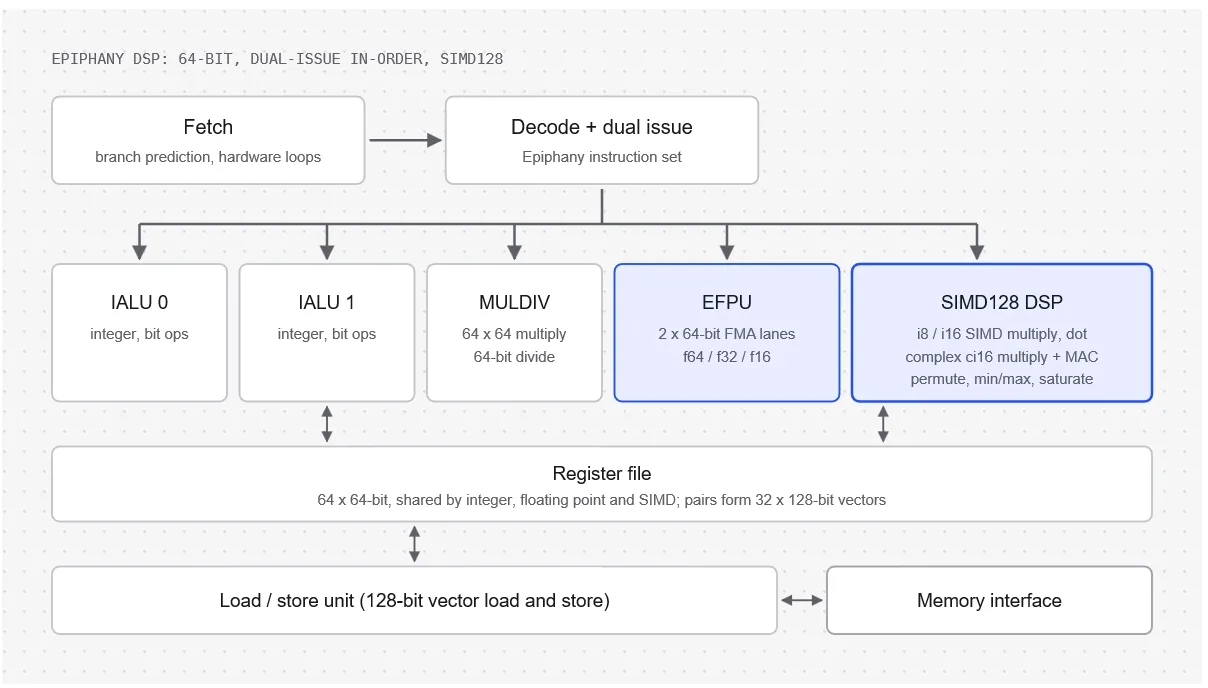
The Epiphany DSP core is a parametric 64-bit dual-issue in-order processor IP core for signal processing, based on the Epiphany instruction set and the SIMD128 extension. SIMD128 is a new 128-bit instruction set extension for floating point, integer and complex arithmetic.
Core Summary
| Feature | Epiphany DSP |
|---|---|
| ISA | E64 + SIMD128 |
| Width | 64-bit |
| Pipeline | dual-issue, in-order |
| Register file | 64 x 64-bit |
| Vector registers | 32 x 128-bit (register pairs) |
| Memory | local SRAM, instruction cache and data cache, sizes configurable |
| Floating point | f64, f32, f16, fused multiply-add |
| Integer SIMD | i8, i16 |
| Complex | ci16 multiply and multiply-accumulate |
| Program flow | branch prediction, hardware loops |
| CoreMark | 4.90 CoreMark/MHz |
| Peak performance | 32 GOPS (i8), 16 GOPS (i16), 8 GFLOPS (f32), 4 GFLOPS (f64) at 1 GHz |
| Clock target | 1 GHz |
SIMD128 Instruction Set
| Category | Operations |
|---|---|
| Floating point | add, subtract, multiply, fused multiply-add, min/max, compare, conversions |
| Integer | multiply, multiply-accumulate, dot product, averaging add/subtract, saturating arithmetic |
| Complex | complex add/subtract, multiply, multiply by conjugate, multiply-accumulate |
| Fixed point | rounding and saturating narrowing |
| Data movement | permute, zip/unzip, extract |
Applications
| Area | Kernels |
|---|---|
| Communications | complex FIR, mixer, correlation, FFT, equalizer, beamforming, power |
| Linear algebra | GEMM, GEMV, dot product, AXPY |
| Signal processing | FIR, biquad, FFT, matrix, statistics |
| Audio | FIR and biquad filters, FFT |
| Image and video | saturating blend, absolute difference, min/max |
Development Tools
| Category | Content |
|---|---|
| Compiler | GCC compiler, assembler, linker |
| Debugger | GDB source-level debugger |
| Simulator | GDB instruction set simulator |
| Math Library | ZKL math and DSP kernel library |
| Build Automation | SiliconCompiler Python-driven build system |
| Emulation | Switchboard system emulation |
IP Deliverables
| Deliverable | File format |
|---|---|
| Datasheet | PDF, HTML |
| Integration Guide | PDF, HTML |
| RTL | Verilog |
| Timing constraints | SDC |
| Testbench | Verilog |
| Build scripts | SiliconCompiler (Python) |
Heritage
The Epiphany architecture has been proven in silicon across several generations of Epiphany processors, up to the 1,024-core Epiphany-V.
Access Model
The Epiphany DSP core is available via commercial IP agreements. Contact our team to learn more about licensing terms and availability.
Block Diagram
Specifications
Identity
Files
Note: some files may require an NDA depending on provider policy.
Provider
Learn more about DSP Core IP core
Zero ASIC releases Platypus 12nm eFPGA product
Zero ASIC announces release of Platypus heterogeneous eFPGA
Zero ASIC releases Wildebeest, the world’s highest performance FPGA synthesis tool
Zero ASIC launches world’s first open standard eFPGA product
Zero ASIC Democratizing Chip Making
Frequently asked questions about DSP Core IP cores
What is Parametric 64-bit dual-issue in-order processor?
Parametric 64-bit dual-issue in-order processor is a DSP Core IP core from Zero ASIC listed on Semi IP Hub.
How should engineers evaluate this DSP Core?
Engineers should review the overview, key features, supported foundries and nodes, maturity, deliverables, and provider information before shortlisting this DSP Core IP.
Can this semiconductor IP be compared with similar products?
Yes. Buyers can compare this product with similar semiconductor IP cores or IP families based on category, provider, process options, and structured technical specifications.