CHERI-D: Secure and efficient inline object ID for CHERI temporal memory safety
By Yuecheng Wang, Jonathan Woodruff, Alfredo Mazzinghi, Peter Rugg, Samuel W. Stark, Alexandre Joannou, Robert N. M. Watson, Simon W. Moore
University of Cambridge, United Kingdom
Abstract
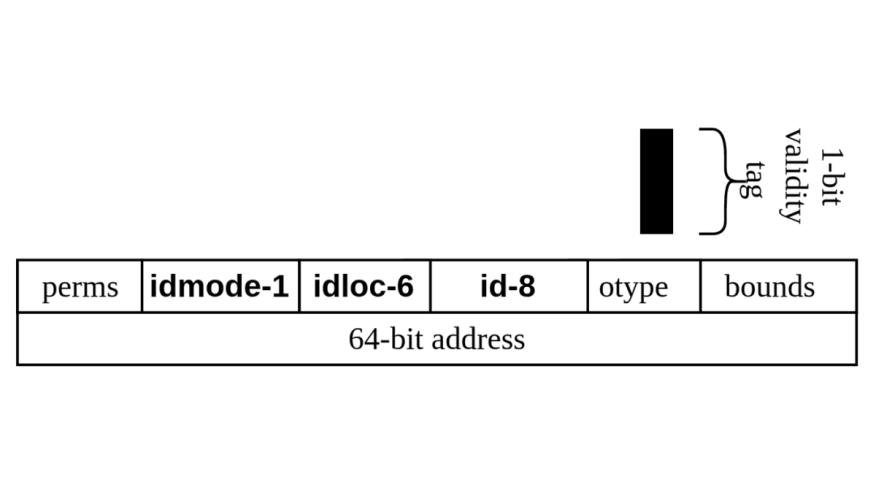
We propose CHERI-D, an architectural extension to CHERI that supports efficient temporal memory safety. Efficient memory safety is an increasing priority for programming languages, operating systems, and hardware designs, and CHERI is a leading hardware/software system that provides native spatial safety and a foundation for temporal memory safety. Due to CHERI lacking intrinsic architectural support for temporal memory safety, the state-of-the-art CHERI temporal safety solution, Cornucopia Reloaded, is a software-based solution that provides use-after-reallocation (UAR) protections instead of the stronger use-after-free (UAF) mitigation, and suffers performance overhead due to delayed reallocation and revocation. CHERI-D associates object identification (ID) metadata with capability pointers to provide temporal integrity of allocations. CHERI spatial safety allows CHERI-D to store object IDs safely inline with allocation data, potentially within unused fragmentation. Evaluated in simulation and in hardware, CHERI-D significantly reduces the revocation overhead of Cornucopia Reloaded while allowing it to support strict use-after-free mitigation.
To read the full article, click here
Related Semiconductor IP
- UALink 200G v1.0 Verification IP
- CCSDS SCCC Demapper and Turbo Decoder
- NPU IP
- JPEG XL Encoder
- I2C Master/Slave Controller Core
Related Articles
- Efficient methodology for design and verification of Memory ECC error management logic in safety critical SoCs
- Efficient Hardware-Assisted Heap Memory Safety for Embedded RISC-V Systems
- Veri-Sure: A Contract-Aware Multi-Agent Framework with Temporal Tracing and Formal Verification for Correct RTL Code Generation
- A 16 nm 1.60TOPS/W High Utilization DNN Accelerator with 3D Spatial Data Reuse and Efficient Shared Memory Access
Latest Articles
- Anechoic: Onsager-Corrected Parallel Annealing for Sub-0.1 ms Dense Max-Cut on an FPGA
- Power, Performance, and Area of HPC-Based Malware Detectors: An FPGA and Open-PDK ASIC Study
- Terracotta: Enabling the Adoption of New DRAM Techniques via a Flexible DRAM Interface and Memory Controller
- A Framework for Accelerating Transformer Inference on RISC-V for Edge AI
- An Interleaved Parallel Dependent Quantization Hardware Architecture for H.266/VVC