A Resource-Efficient CNN-Based EEG Auditory Attention Decoding ASIC
By Qier Ma 1, Richard George 1, Stefan Scholze 1, Jehn Constantin 2, Tobias Reichenbach 2, and Christian Mayr 1
1 Department of Electrical Engineering and Information Technology, Institute of Circuits and Systems, Chair of Highly-Parallel VLSI Systems and Neuro-Microelectronics, Technische Universitat Dresden, Dresden, Germany
2 Department of Artificial Intelligence in Biomedical Engineering (AIBE), Friedrich-Alexander-Universitat Erlangen–Nurnberg (FAU), Erlangen, Germany
Abstract
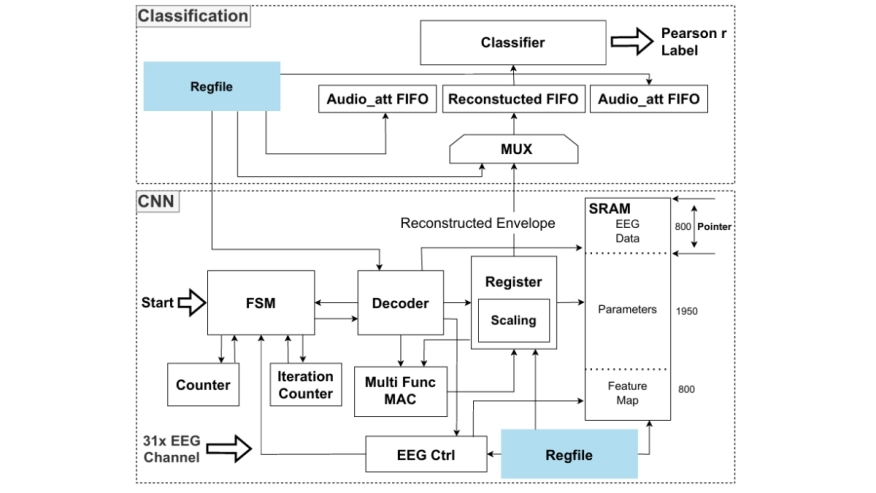
Following a target speaker in a noisy environment, commonly known as the cocktail party problem, remains particularly challenging for cochlear implant (CI) users. Recent studies have explored EEG-based auditory attention decoding (AAD) using neural networks to enhance hearing assistance. This paper presents a resource-efficient ASIC for real-time EEG-based auditory attention decoding by integrating a quantized CNN inference engine and a Pearson-correlation classifier. The proposed architecture employs streaming execution, on-chip buffering, and memory-efficient dataflow to reduce hardware cost while maintaining real-time performance.
The proposed ASIC has been fully implemented in GF22FDX 22-nm CMOS technology, occupying a total silicon area of 2.09 mm2 (1264μm x 1654μm), with the CNN inference engine and streaming classification engine requiring only 0.076 mm2. Operating at a core voltage of 0.55 V, the design achieves a power consumption of 0.4941 mW and an inference latency of 7.34 ms, providing an energy-efficient hardware platform for EEG-based auditory attention decoding in hearing-assistance applications.
Index Terms—Auditory Attention Decoding (AAD), EEG, ASIC, Low-Power Design, Cochlear Implant, CNN
To read the full article, click here
Related Semiconductor IP
- RISC-V-Based, Open Source AI Accelerator for the Edge
- Embedded AI accelerator IP
- Performance AI Accelerator for Edge Computing
- Performance Efficiency AI Accelerator
- Low power AI accelerator
Related Articles
- A 0.32 mm² 100 Mb/s 223 mW ASIC in 22FDX for Joint Jammer Mitigation, Channel Estimation, and SIMO Data Detection
- Pipeline Stage Resolved Timing Characterization of FPGA and ASIC Implementations of a RISC V Processor
- A 14ns-Latency 9Gb/s 0.44mm² 62pJ/b Short-Blocklength LDPC Decoder ASIC in 22FDX
- A Persistent-State Dataflow Accelerator for Memory-Bound Linear Attention Decode on FPGA
Latest Articles
- Automated Pre-Silicon Verification of High-Speed DDR5 and LPDDR5/6 Memory Controllers: Closed-Loop Timing, Mode Register, and PHY Synchronization in UVM
- U-Sonic: An Open-Source 8-Channel Ultrasound Transmit IP in a 130 nm RISC-V SoC
- S-ALSA: Co-Design of Adiabatic Logic-based Sensing and Balanced Bit-Cells for Secure and Energy-Efficient MRAM
- MEGATRON: a 28nm Analog PCM CiM/Digital System-on-Chip for Edge GenAI at 57.5 TOPS/W and 1.52 Mparam/mm²
- Peregrino: A Full-Hardware Accelerator for the Complete Falcon Post-Quantum Digital Signature Scheme on Resource-Constrained Edge Devices