CEA-Leti Looks Beyond SRAM and DRAM as AI Reshapes the Memory Roadmap
CEA-Leti’s François Andrieu describes more embedded, persistent, and low-energy memories that will meet the growing demands of AI.
By Pat Brans, EE Times | July 22, 2026
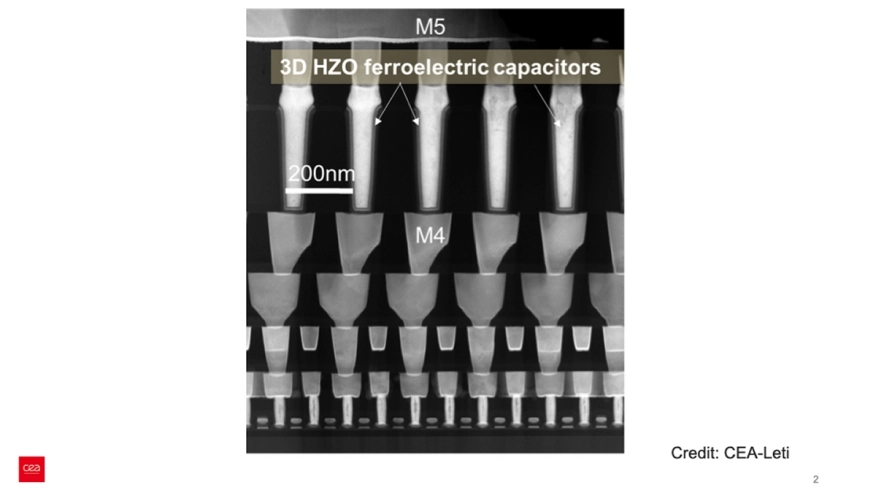
As AI pushes more data through processors, accelerators, and embedded systems, CEA-Leti is rethinking the memory roadmap. The institute is not betting on a single emerging technology to replace SRAM, DRAM, or NAND flash. Instead, it sees new memories filling the gaps to create a more diverse hierarchy adapted to AI’s need for more capacity, lower energy, and closer proximity to compute.
For François Andrieu, head of the memory lab at CEA-Leti and a Leti fellow, the roadmap now follows two main tracks. “One is rooted in Leti’s long-standing work on embedded nonvolatile memory [eNVM], mainly for microcontroller applications,” he told EE Times. “The other is driven by AI, where the challenge is to keep more information close to the compute engines that need it.”
To read the full article, click here
Related Semiconductor IP
- SRAM Memory Model
- QDR II SRAM Controller Intel® FPGA IP Function
- QDR II SRAM Controller Intel® FPGA IP
- ZBT SRAM memory controller
- SRAM Test Solution
Related News
- French Team Led by CEA-Leti Develops First Hybrid Memory Technology Enabling On-Chip AI Learning and Inference
- CEA-Leti and Fraunhofer IPMS Validate Wafer Exchange for Ferroelectric Memory Materials Within the FAMES Pilot Line
- JEDEC Advances DDR5 MRDIMM Ecosystem with New Memory Interface Logic and Expanded MRDIMM Roadmap
- CEA-Leti Scales Ferroelectric RAM to 22nm Node, Unlocking Denser, More Efficient Memory for Edge AI
Latest News
- BrainChip Launches AKD1500 Raspberry Pi 5 Kit: Giving Developers a Direct Path from Prototype to Production
- Cadence Joins the Genesis Mission Consortium to Advance AI-Driven Scientific Discovery and Microelectronics Innovation
- Onsemi picks up Codasip’s low-end RISC-V business for $14.5 million
- Semidynamics and Nokia Explore Collaboration to Strengthen Europe’s Sovereign AI Capabilities
- VeriSilicon Introduces GLTiny™ 3D GPU Programming Model for Ultra-Low-Power, Memory-Efficient Wearable Devices