A scalable, shader-programmable vector graphics GPU core for low-power MCUs

By TES Electronic Solutions, with appreciated help from ChatGPT5.6, and Gemma4:31b
In sectors ranging from low-power wearables to general purpose MCUs and MPUs, the demand for responsive, visually appealing graphics is rising. However, semiconductor designers must still balance these ambitions against stringent power, cost, and memory constraints. Selecting the right GPU hardware and software architecture for complete product portfolios is therefore a key design decision.
To meet the growing graphics demands, the industry is shifting toward scalable, shader programmable architectures. Unlike fixed-function graphics accelerators, shader programmable GPUs offer the flexibility required to target diverse market segments and at the same time ensure software portability and maintainability. Furthermore, adopting platform-independent stacks based on industry standards allows accelerating time-to market by developing applications on standard PC platforms before deployment to target hardware.
 TES Electronic Solutions in Germany addresses these challenges with the D/AVE NX GPU core. Engineered specifically for resource-constrained environments, it supports OpenGL ES 2.0 shader programmability with selected 3.x and vector graphics extensions.
One distinguishing feature is its support for offline shader compilation: by compiling shaders during development time rather than at runtime, the system drastically reduces RAM consumption down to a few megabytes instead of tens of megabytes. Additionally, offline compiled shaders ensure the deterministic behavior required for safety critical systems.
All D/AVE NX drivers are OS-independent and thus ensure seamless integration across bare metal, RTOS, and Linux environments. This in combination with the low RAM requirements and low CPU load makes D/AVE NX suitable even for MCUs with limited embedded memory.
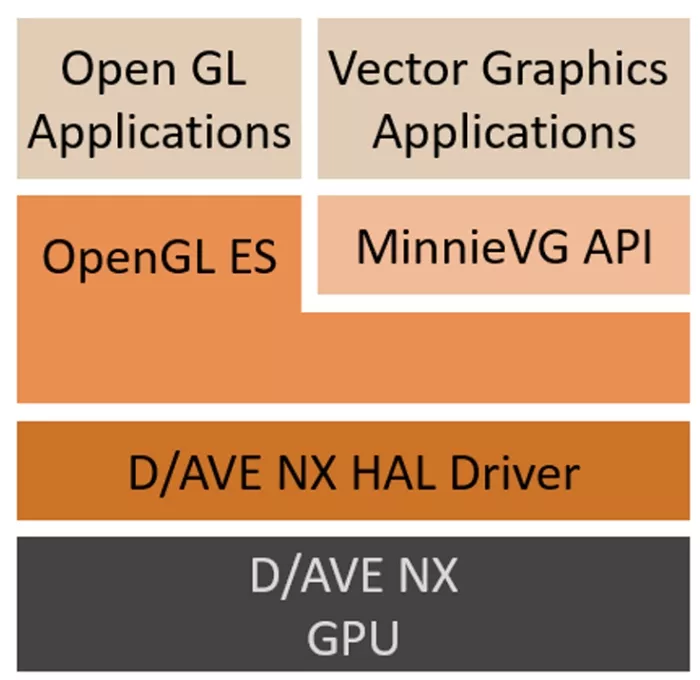
D/AVE NX Software Stack
Beyond programmable graphics, D/AVE NX integrates an n-polygon rasterizer for accelerated vector graphics rendering. This is complemented by the MinnieVG vector graphics library, which provides a simplified API that enables non-specialists to achieve high-quality, anti-aliased rendering without sacrificing OpenGL ES 2.0 compatibility.

“Ghostscript Tiger” rendered with MinnieVG on D/AVE NX
By offering scalable configurations, ranging from a single shader unit with 4 ALUs to four shader units with up to 128 ALUs in total, D/AVE NX allows semiconductor vendors to optimize performance versus silicon area and power consumption, while maintaining a unified software foundation across entire product families. This synergy of scalability and software compatibility is essential for deploying modern graphics capabilities across product ranges from low-power MCUs up to MPUs.
For additional technical information, visit the D/AVE NX product page: https://www.tes-dst.com/technology-products/gpus/d/ave-nx/
Explore TES Electronic IP:
- OpenGL ES 2.0 3D graphics IP core for FPGAs and ASICs
- 2.5D GPU
- 2D GPU Hardware IP Core
- 3D OpenGL ES 1.1 GPU IP core
Related Semiconductor IP
- OpenGL ES 2.0 3D graphics IP core for FPGAs and ASICs
- 2.5D GPU
- 2D GPU Hardware IP Core
- 3D OpenGL ES 1.1 GPU IP core
- Warping Engine IP Core
Related Blogs
- A New Era for Edge AI: Codasip’s Custom Vector Processor Drives the SYCLOPS Mission
- Designing the Beam Steering Core for a C-Band AESA: A Look at VSI's VBF0644 GaAs Beamformer IC
- IDS-NoC: A Scalable Interconnect Solution for Modern SoC Design
- Vivante Vega GPU Geometry and Tessellation Shader Overview
Latest Blogs
- Tape-Out Readiness Checklist: Engineering Decisions That Prevent Costly Respins
- How Cadence DSPs Put In-Cabin AI Audio On-Chip in SemiDrive's X10
- The Fastest Path to Scalable Photonic Systems: Using Proven IP for both PIC and EIC designs
- Building Trusted AI Agents from the Silicon Root of Trust
- Heterogeneous Computing in Space