Overview
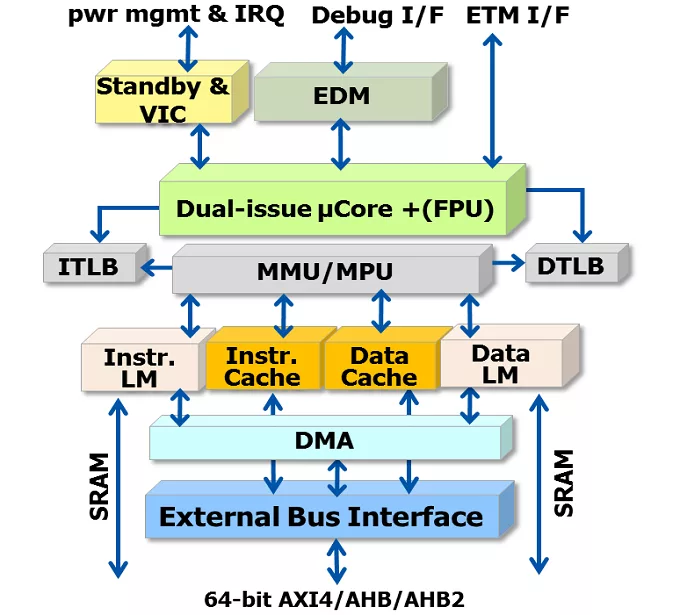
N15/N15F are dual-issue superscalar AndesCore™ processors capable of delivering performance at 5.41 CoreMark/MHz, the highest among the same level products in the industry. N15/N15F comes with a variety of configuration options, including MMU, cache and local memory. The 64-bit data buses for caches, local memory and the main bus provide the bandwidth needed for instruction fetch and data access. N15F includes a built-in IEEE-754 compliant floating point unit that enhances the floating point processing capability. N15/N15F is designed for diversified performance-driven applications on the embedded Linux, Real-Time OS or bare metal environment.
Learn more about CPU IP core
本月,头部数字EDA企业思尔芯宣布,荣获RISC-V处理器IP领导厂商Andes晶心科技(Andes Technology)颁发的“2026年度最佳合作伙伴”奖项。该荣誉旨在表彰思尔芯在RISC-V生态共建、原型验证平台支撑及联合市场拓展中与Andes晶心深度协同、持续创造客户价值的突出表现。
This award recognizes Quintauris’ exceptional dedication to develop reference architectures and advancing mass-market commercialization for the RISC-V ecosystem with Andes.
Based on Visual Studio Code (VS Code), it is integrated, lightweight, and designed to streamline the development experience by bringing Andes’ industry-leading toolchain and advanced debugging capabilities directly into the most popular integrated development environment (IDE).
Built upon the production-proven D23 architecture, the 32-bit D23-SE processor is specifically engineered for safety-critical systems requiring deterministic performance, robust security mechanisms, and accelerated SoC compliance workflow.
This milestone release addresses one of the industry’s most challenging hurdles: enabling resource-heavy Transformer architectures such as Vision Transformers (ViT), Vision-Language Models (VLMs), and Small Language Models (SLMs) to execute efficiently on power- and cost-constrained edge platforms.
Validated Architecture Models Enable Early Design Exploration and Pre-RTL Optimization