Vendor: Cadence Design Systems, Inc. Category: Single-Protocol PHY

PHY for PCIe 3.1

The first IP for PCIe 3.1 with L1 sub-states support

Overview

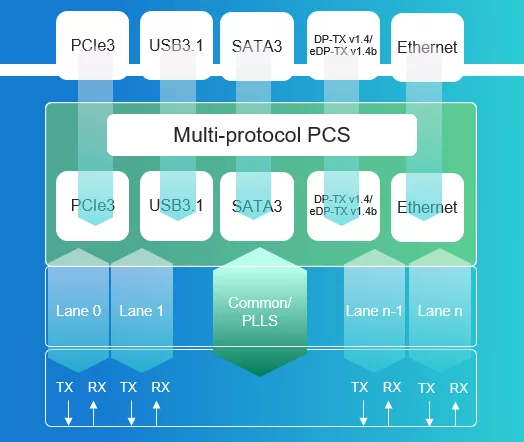
The Cadence IP for 10Gbps Multi-Protocol PHY IP is a lower active and low leakage power design crafted for mobile, IoT, consumer, and automotive designs. The PHY IP is designed for multi-protocols running on a single PHY macro and is compliant with USB 3.1, PCI Express® (PCIe®) 3.1, DisplayPort TX v1.4, Embedded DisplayPort TX v1.4b, SATA 3, 10G-KR and QSGMII/SGMII specifications. The PCS complies with the PIPE 4.x interfaces and supports dynamic equalization features of different protocols. ​

Key features

  • Supports PCIe 3.1, USB 3.1, DP-TX v1.4/eDP-TX v1.4b, SATA 3, 10G-KR and QSMII/SGMII
  • Multi-protocol support for simultaneous independent links
  • Supports SRIS and internal SSC generation
  • Supports PCIe L1 sub-states
  • Automatic calibration of on-chip termination resistors
  • Supports internal and external clock sources with clock active detection
  • SCAN, BIST, and serial/parallel loopback functions

Block Diagram

Benefits

  • Multi-Protocol with Multi-Link Capability: Single-PHY macro offers optimum SoC configurability with the protocol mix and match
  • Optimized Performance, Power, and Area: Best fit for the application's required performance with small footprint
  • Comprehensive Test Feature Enables Rapid SoC Development: Extensive BIST and DFT enable ease of integration, faster bring-up, and quick debugging

What’s Included?

  • PMA Hard Macro
  • PCS-BIST Soft Macro
  • Datasheet
  • SoC integration guide
  • Optional design integration and bring-up support services

Specifications

Identity

Part Number
PHY for PCIe 3.1
Vendor
Cadence Design Systems, Inc.
Type
Silicon IP

Standards & Interfaces

Supported Standards
PCIe Gen3

Files

Note: some files may require an NDA depending on provider policy.

Provider

Learn more about Single-Protocol PHY IP core

Rethinking AI Infrastructure: The Rise of PCIe Switches

Far from just a functional piece of hardware, PCIe switches are the invisible foundation that accelerates data processing, eliminates bottlenecks, and ensures modern AI systems operate with blazing speed and pinpoint precision.

UALink Under the Hood: Why Full-Stack Verification Wins

Verifying UALink means following a transaction the way the silicon does: down through four layers, out across one, two, or four SerDes lanes at the configured 100G or 200G serial rate, and back again, with its meaning and its bytes both intact. This blog takes that journey one layer at a time, and along the way examines a detail of the data link flit that is easy to overlook and important to get right.

A Look at New Open Standards to Improve Reliability and Redundancy of Automotive Ethernet

To meet the safety and deterministic latency requirements for controlling a car, a new set of open standards is being developed, collectively referred to as “Time Sensitive Networking,” or TSN. These improve the reliability, timing, redundancy, and failure detection ability of Ethernet to the level where it can be applied throughout an automobile. This article describes how Cadence has addressed the hardware requirements of TSN in its Automotive Ethernet Media Access Controller (MAC).

Frequently asked questions about Single-Protocol PHY IP

What is PHY for PCIe 3.1?

PHY for PCIe 3.1 is a Single-Protocol PHY IP core from Cadence Design Systems, Inc. listed on Semi IP Hub.

How should engineers evaluate this Single-Protocol PHY?

Engineers should review the overview, key features, supported foundries and nodes, maturity, deliverables, and provider information before shortlisting this Single-Protocol PHY IP.

Can this semiconductor IP be compared with similar products?

Yes. Buyers can compare this product with similar semiconductor IP cores or IP families based on category, provider, process options, and structured technical specifications.

×
Semiconductor IP