Vendor: CAST Category: MIPI

MIPI SPMI Controller or Target

The SPMI-CTRL core implements a featured, easy-to-use controller for the MIPI System Power Management Interface (MIPI-SPMI) bus.

Overview

The SPMI-CTRL core implements a highly featured, easy-to-use controller for the MIPI System Power Management Interface (MIPI-SPMI) bus. It supports the latest version (v2.0) of the MIPI-SPMI specification, and is suitable for the implementation of either controller or target nodes in an SPMI bus.

The core is designed to minimize the software load on the host processor. Once configured, the core requires no assistance from the host to initialize the bus, connect to bus or disconnect from the bus, grant access of the bus, execute incoming SPMI commands, generate ACK/NACK responses, and check address and data parity. 

Although the core only expects the host to provide the outgoing SPMI commands, it provides thorough status information to the host, which can be used for a higher application layer or for debugging purposes. Last received command, outgoing command status, bus status, and node operation status are made available to the host via the core’s registers. Parity errors, unknown commands, or failure of receiving node to provide ACK/NACK response are also reported. Furthermore, the core can be programmed to operate in debug mode, under which the core captures and reports all SPMI bus commands regardless of the destination address. 

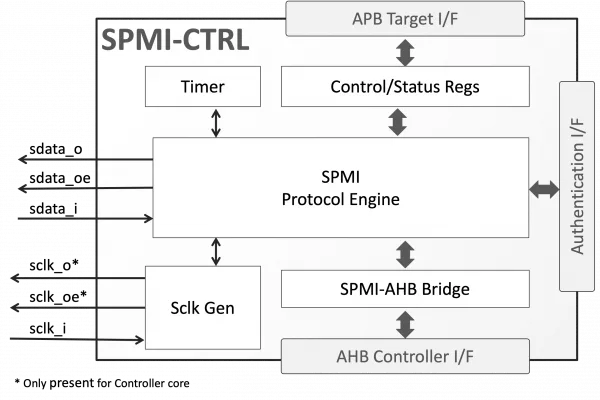
Integration of the core is extremely simple: The core provides access to its registers via a AMBA™ 2 APB target interface, and converts the incoming SPMI read/write commands to accesses on its AHB controller port. This SPMI-AHB bridging allows easy mapping of the SPMI address space to shared memories or peripheral registers. A dedicated interface allows integration with application specific authentication logic, which can be reduced to just hardwiring the authentication response data. The core uses separate clocks for its APB and AHB bus interfaces, and a separate reference clock source for its internal timer. Clocks are independent to each other, with clean clock domain crossing boundaries, and the only requirement is that the AMBA interface clocks have a frequency larger or equal to the maximum SPMI clock frequency.
 
The core is designed with industry best practices, and its reliability has been proven through rigorous verification. 
Key features

  • MIPI-SPMI v2.0 Controller or Target
    • Supports High Speed (HS) and Low Speed (LS) device classes
      • Serial clock frequencies from 32kHz to 26MHz
    • Supports all commands, including Block, Extended and Extended Long Read/Writes
    • Supports all arbitration levels. Suitable for multi-controller and/or multi-target busses.
    • Configurations: 
      • Arbitration-Capable Controller
      • Non-Arbitration-Capable Controller
      • Request-Capable Target 
      • Non-Request-Capable Target
  • Low Host Overhead
    • Autonomously performs bus initialization, bus connect/disconnect, and bus arbitration
    • Autonomously executes all incoming SPMI commands, and generates ACK/NACK responses
    • Host is only required to: a) initialize register values after a reset b) define outgoing commands and arbitration levels and c) optionally respond to reported errors
  • Run-time Debugging Features
    • Broadcasts SPMI bus state and device state
    • Detects and reports parity, bus or command errors
    • Under debug mode captures all traffic in the SPMI bus
    • Run-time programmable identifiers (Controller, Target and up to 6 Group Target Identifiers per device)
  • Easy Integration
    • Directly bridges SPMI and AHB bus address space, allowing SPMI address space mapping either to a shared memory or directly to peripheral registers
    • Register access via 32-bit AMBA™ 2 APB bus
  • Small and Low Power
    • Less than 6,000 Gates for either the controller or the target core
    • Direct serial clock usage to minimize switching activity when idle

Block Diagram

Specifications

Identity

Part Number
SPMI-CTRL
Vendor
CAST
Type
Silicon IP

Files

Note: some files may require an NDA depending on provider policy.

Provider

HQ: USA

Learn more about MIPI IP core

M31 High-Speed and Long-Channel MIPI C/D-PHY Solution on TSMC N3P/N3C

With the rapid growth of AR/VR and high-resolution imaging systems such as drones and action cameras, MIPI CSI (Camera Serial Interface) and MIPI DSI (Display Serial Interface) require both high data throughput and low power consumption. M31 provides a MIPI C-PHY and D-PHY IP combo solution implemented on TSMC N3P and N3C processes.

MIPI CCI over I3C: Faster Camera Control for SoC Architects

Imagine a camera subsystem that responds in microseconds, consumes less power, and offers a more straightforward route to time-to-market. For SoC architects and IP integration teams, that vision is increasingly possible with MIPI Camera Control Interface (CCI) over I3C.

MIPI MPHY 6.0: Enabling Next-Generation UFS Performance

High-speed chip-to-chip data transfer is continuously evolving to meet increasing performance demands. MIPI MPHY is a high-speed physical layer interface developed by the MIPI Alliance. This protocol is used for high-speed chip-to-chip interfaces, mainly in mobile and automotive devices.

MIPI: Powering the Future of Connected Devices

From the first monochrome mobile displays to today’s ultra-high-definition automotive dashboards and immersive AR/VR headsets, MIPI technology has quietly become the backbone of modern data connectivity. Let’s explore how MIPI standards have evolved, the markets they serve, and why Rambus is at the forefront of this transformation.

Frequently asked questions about MIPI IP cores

What is MIPI SPMI Controller or Target?

MIPI SPMI Controller or Target is a MIPI IP core from CAST listed on Semi IP Hub.

How should engineers evaluate this MIPI?

Engineers should review the overview, key features, supported foundries and nodes, maturity, deliverables, and provider information before shortlisting this MIPI IP.

Can this semiconductor IP be compared with similar products?

Yes. Buyers can compare this product with similar semiconductor IP cores or IP families based on category, provider, process options, and structured technical specifications.

×
Semiconductor IP