Vendor: Cadence Design Systems, Inc. Category: MIPI PHY

MIPI D-PHY

D-PHY physical layer

MIPI D-PHY TSMC 7nm N7+ Silicon Proven View all specifications

Overview

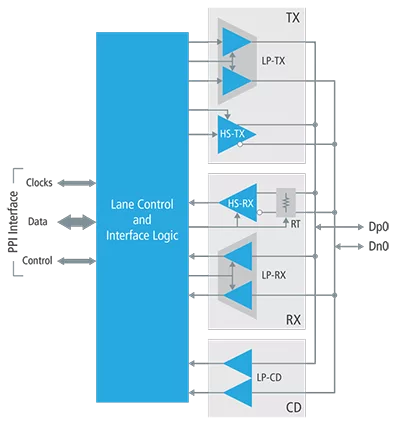
The Cadence IP for MIPI® D-PHYsm integrates a high-speed transmitter/receiver, low-power transmitter/receiver, and low-power contention detector that provide the full function of D-PHY. Our IP has an integrated PPI interface for ease-of-integration with MIPI CSI-2 and DSI controllers.

The Design IP for MIPI D-PHY provides lane flexibility with a compact and rectangular IP footprint, meeting usage models of modern SoCs. The pre-integrated CSI-2 and DSI solution ensures the interoperability and makes this PHY easy to integrate, shortening the product's time to market.

Key features

  • Multiple Configurations Possible. TX-only (with integrated PLL), RX-only, and combined TX and RX configurations
  • Complete Function for HS TX/RX, LP TX/RX, and LPCD with automatic termination control for high-speed and low-power modes
  • Integrated BIST Capable of producing and checking PRBS, CRPAT, and CJTPAT

Block Diagram

Benefits

  • Available as Pre-Integrated Solution with Controller: Cadence CSI-2 and DSI supported
  • Scalable, Modular Design: Compact and regular footprint
  • Supports Advanced FinFET Processes: 16nm, 12nm, and 7nm processes supported

Applications

  • Automotive,
  • Communications,
  • Consumer Electronics,
  • Data Processing,
  • Industrial and Medical,
  • Military/Civil Aerospace,
  • Others

What’s Included?

  • GDS II macros with abstract in LEF
  • Verilog post-layout netlist
  • STA scripts for use at chip or standalone PHY levels
  • Liberty timing model
  • SDF for back-annotated timing verification

Silicon Options

Foundry Node Process Maturity
TSMC 7nm N7+ Silicon Proven

Specifications

Identity

Part Number
MIPI D-PHY
Vendor
Cadence Design Systems, Inc.
Type
Silicon IP

Standards & Interfaces

MIPI PHY
MIPI D-PHY

Files

Note: some files may require an NDA depending on provider policy.

Provider

Learn more about MIPI PHY IP core

MIPI MPHY 6.0: Enabling Next-Generation UFS Performance

High-speed chip-to-chip data transfer is continuously evolving to meet increasing performance demands. MIPI MPHY is a high-speed physical layer interface developed by the MIPI Alliance. This protocol is used for high-speed chip-to-chip interfaces, mainly in mobile and automotive devices.

Industry’s First End-to-End eUSB2V2 Demo for Edge AI and AI PCs at CES

Earlier this year, Cadence achieved a major milestone with the tapeout of the first 3nm eUSB2V2 PHY test chip, now fully validated and completing silicon characterization. Building on this success, Cadence has developed a complete end-to-end eUSB2V2 solution, including both host and device controller IP.

A Look at New Open Standards to Improve Reliability and Redundancy of Automotive Ethernet

To meet the safety and deterministic latency requirements for controlling a car, a new set of open standards is being developed, collectively referred to as “Time Sensitive Networking,” or TSN. These improve the reliability, timing, redundancy, and failure detection ability of Ethernet to the level where it can be applied throughout an automobile. This article describes how Cadence has addressed the hardware requirements of TSN in its Automotive Ethernet Media Access Controller (MAC).

Frequently asked questions about MIPI PHY IP

What is MIPI D-PHY?

MIPI D-PHY is a MIPI PHY IP core from Cadence Design Systems, Inc. listed on Semi IP Hub. It is listed with support for tsmc Silicon Proven.

How should engineers evaluate this MIPI PHY?

Engineers should review the overview, key features, supported foundries and nodes, maturity, deliverables, and provider information before shortlisting this MIPI PHY IP.

Can this semiconductor IP be compared with similar products?

Yes. Buyers can compare this product with similar semiconductor IP cores or IP families based on category, provider, process options, and structured technical specifications.

×
Semiconductor IP