Vendor: CAST Category: Video Processing

Low-Power AVC/H.264 Baseline Profile Decoder

The H264-LD-BP IP core implements a silicon and energy efficient hardware video decoder able to process H.264 streams produced by…

Overview

The H264-LD-BP IP core implements a silicon and energy efficient hardware video decoder able to process H.264 streams produced by the H264-E-BPS, H264-E-BPF and H264-E-BIS video encoder cores available from CAST.  

The H264-LD-BP is extremely small, requiring less than 70k gates and about 60k bits of infernal memory. Its small silicon footprint, low bandwidth requirements, and zero software-overhead enable extremely cost-effective and low-power ASIC and FPGA implementations.   

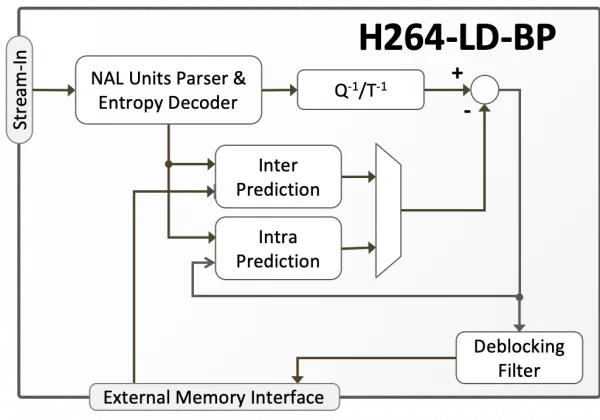
The H264-LD-BP is designed for straightforward, trouble-free SoC integration. It operates on a stand-alone basis such that decoding proceeds without any assistance or input from the host processor. The decoder’s memory interface—used to store reconstructed video data—is extremely flexible: it operates on a separate clock domain, is independent from the external memory type and memory controller, and is tolerant to relatively large latencies. The decoder reports decompressed video parameters, detects and reports bit stream errors to the system, and simplifies video cropping at its output. The core is optionally delivered with a raster-to-block converter, and wrappers for AMBA® AHB, AXI, or AXI-Streaming buses are available. 

Customers can further decrease their time to market by using CAST’s integration services to receive complete video encoding/decoding subsystems. These integrate the decoder core with video encoders, video and networking interface controllers, networking stacks, or other CAST or third-party IP cores.  

The H264-LD-BP IP core is designed using industry best practices and has been multiple times production proven. Its deliverables include a complete verification environment and a bit-accurate software model.
Key features

  • Low-power AVC/H.264 decoder, with small silicon footprint; optimized for low-latency, low-bit-rate video streaming
  • Decodes streams produced by the H264-E-BPS, H264-E-BPF, and H264-E-BIS cores
  • Video Formats
    • Progressive or Interlaced, 4:2:0 YCbCr with 8 bits per color sample
    • Single-channel SD, ED, and Full-HD capable even in low-cost FPGAs
    • Optional multichannel decoding
  • Small and Low-Power
    • Less than 70 KGates and 60k bits of RAM
    • Less than half the typical silicon footprint and small external memory bandwidth mean it uses less power than competitive hardware H.264 decoders
    • Consumes much less power than any equivalent software or software-hardware decoder
  • Ease of Integration
    • Zero CPU overhead, stand-alone operation
    • Flexible external memory interface. Uses a separate clock, is independent of memory type and tolerant to latencies
    • AMBA® Interface Options: DMA-capable AMBA® AHB, AXI or AXI-Streaming
  • Supported Coding Tools
    • I and P Slices
    • Single Reference Frame
    • Motion vector up to –32.00/+31.75 pixels down to ¼ pel accuracy
    • All intra16x16 and most intra 4x4 modes
    • Multiple slices per frame
    • Block skipping
    • Deblocking filter

Block Diagram

What’s Included?

  •     Source-code HDL (Verilog or VHDL) (ASICs) or as a targeted netlist (FPGAs) 
  •     Sophisticated self-checking Testbench  
  •     Synthesis scripts. 
  •     Simulation script, vectors and expected results. 
  •     Comprehensive user documentation.  
     

Specifications

Identity

Part Number
H264-LD-BP
Vendor
CAST
Type
Silicon IP

Compute

Codec Standard
H.264 / AVC

Files

Note: some files may require an NDA depending on provider policy.

Provider

HQ: USA

Learn more about Video Processing IP core

Understanding - and Reducing - Latency in Video Compression Systems

In the video world, latency is the amount of time between the instant a frame is captured and the instant that frame is displayed. Low latency is a design goal for any system where there is real-time interaction with the video content, such as video conferencing or drone piloting.

Understanding - and Reducing - Latency in Video Compression Systems

In the video world, latency is the amount of time between the instant a frame is captured and the instant that frame is displayed. Low latency is a design goal for any system where there is real-time interaction with the video content, such as video conferencing or drone piloting. But the meaning of “low latency” can vary, and the methods for achieving low latency aren’t always obvious. Here we’ll define and explain the basics of video latency, and discuss how one of the biggest impacts in reducing latency comes from choosing the right video encoding.

CANsec: Security for the Third Generation of the CAN Bus

CANsec is a resource-efficient solution for securing the CAN bus against the most common cyber security threats on software-defined vehicles. Here we show that the encryption and authentication of CAN XL frames are possible without latencies or loss...

Time Sensitive Networking for Aerospace

This white paper highlights the integration of Time-Sensitive Networking (TSN) in the aerospace industry. It provides an overview of TSN standards and profiles and the IEEE P802.1DP standard relevant to aerospace applications. It also discusses key topics such as time synchronization, latency, resource management, and reliability in the context of TSN.

Frequently asked questions about Video Processing IP

What is Low-Power AVC/H.264 Baseline Profile Decoder?

Low-Power AVC/H.264 Baseline Profile Decoder is a Video Processing IP core from CAST listed on Semi IP Hub.

How should engineers evaluate this Video Processing?

Engineers should review the overview, key features, supported foundries and nodes, maturity, deliverables, and provider information before shortlisting this Video Processing IP.

Can this semiconductor IP be compared with similar products?

Yes. Buyers can compare this product with similar semiconductor IP cores or IP families based on category, provider, process options, and structured technical specifications.

×
Semiconductor IP