Overview
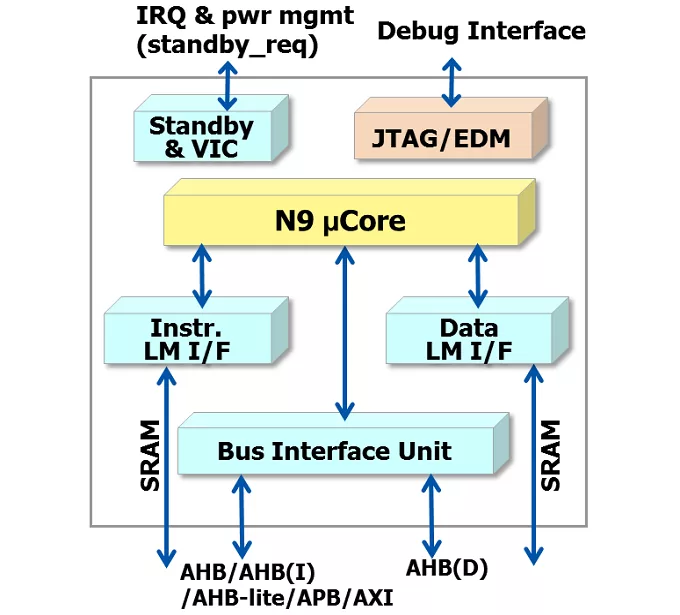
The AndesCore N9 Family is intended for deeply embedded applications that require optimal interrupt response features, including wireless networking and sensors, micro-controllers, automotive electronics, and industrial control systems. The low-power N9 Family of processors features low gate count, low interrupt latency, and low-cost debug. The processor family provides superior performance and excellent interrupt handling response while meeting the challenges of low dynamic and static power constraints.
The AndesCore N9 Family of CPU cores implement v3, the AndeStar™ patented 32-bit RISC-style CPU architecture. The designer can configure certain parameters to adjust the CPU’s size, power, and performance. For example, the N9 core can be configured with 16 or 32 general registers, two or three read ports on the register file, one or two write ports, a fast or a small multiplier, a 24-bit or 32-bit address space, and different bus (APB, AHB, AHB-Lite, AXI) interfaces to connect to the rest of the system.
Learn more about CPU IP core
本月,头部数字EDA企业思尔芯宣布,荣获RISC-V处理器IP领导厂商Andes晶心科技(Andes Technology)颁发的“2026年度最佳合作伙伴”奖项。该荣誉旨在表彰思尔芯在RISC-V生态共建、原型验证平台支撑及联合市场拓展中与Andes晶心深度协同、持续创造客户价值的突出表现。
This award recognizes Quintauris’ exceptional dedication to develop reference architectures and advancing mass-market commercialization for the RISC-V ecosystem with Andes.
Based on Visual Studio Code (VS Code), it is integrated, lightweight, and designed to streamline the development experience by bringing Andes’ industry-leading toolchain and advanced debugging capabilities directly into the most popular integrated development environment (IDE).
Built upon the production-proven D23 architecture, the 32-bit D23-SE processor is specifically engineered for safety-critical systems requiring deterministic performance, robust security mechanisms, and accelerated SoC compliance workflow.
This milestone release addresses one of the industry’s most challenging hurdles: enabling resource-heavy Transformer architectures such as Vision Transformers (ViT), Vision-Language Models (VLMs), and Small Language Models (SLMs) to execute efficiently on power- and cost-constrained edge platforms.
Validated Architecture Models Enable Early Design Exploration and Pre-RTL Optimization