ZLG Selects CAST CAN XL and TSN IP for Next-Generation Vehicle-Network Development and Test Tools
Standards-compliant IP supports CAN XL tools and deterministic Ethernet switches for OEM R&D, production, and testing
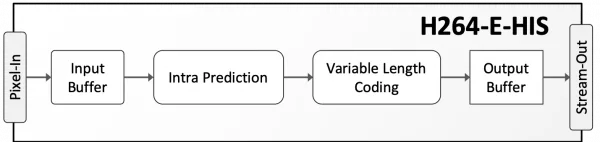
The H264-E-HIS IP core is a video encoder compliant to the High 10 Intra profile of the ISO/IEC 14496-10/ITU-T H.264 standard.
The H264-E-HIS IP core is a video encoder compliant to the High 10 Intra profile of the ISO/IEC 14496-10/ITU-T H.264 standard. The encoder core has a small silicon footprint—approximately 220K gates and 280K to 420K bits of SRAM—and requires no external memory (e.g. off-chip DRAM) allowing for very cost-effective and low-power ASIC or FPGA implementations.
Despite its small size, the H264-E-HIS implements a highly efficient intra-frame compression engine. When measured at the same bit rate, the video quality of the compressed streams it produces exceeds that of Motion-JPEG and is similar to or better than the video quality of Motion JPEG2000. Being intra-coded, the produced H.264 streams feature high error resilience, allow for random access in the compressed stream, and ease video editing. Furthermore, the core can output both Variable Bit-Rate (VBR) and Constant Bit0-Rate (CBR) video. The core autonomously produces VBR streams, while CBR streams can be produced when quantization is externally adjusted on frame boundaries.
The core was designed for ease of use and integration. Once initially programmed, it compresses an arbitrary number of frames without any assistance from the host processor. Moreover, the core does not require any external memory (such as an off-chip DRAM) for its operation, and features FIFO-like flow-controllable interfaces for the pixel and compressed stream data. The core is optionally delivered with a raster-to-block converter, and bridges to AXI-Stream or Avalon Streaming interfaces.
Customers can further decrease their time to market by using CAST’s integration services to receive complete video encoding subsystems. These integrate the encoder core with video and networking interface controllers, networking stacks, or other CAST or third-party IP cores.
Note: some files may require an NDA depending on provider policy.

H.264 High 10 Intra Profile Encoder is a Video Processing IP core from CAST listed on Semi IP Hub.
Engineers should review the overview, key features, supported foundries and nodes, maturity, deliverables, and provider information before shortlisting this Video Processing IP.
Yes. Buyers can compare this product with similar semiconductor IP cores or IP families based on category, provider, process options, and structured technical specifications.