Arasan to demonstrate the industry's first MIPI SWI3S™ IP at the MIPI Member meet in Taipei
Arasan provides a Total SWI3S™ IP Solution including the SWI3S™ PHY which will be available on multiple foundry nodes 22nm and below.
The Gigabit Ethernet Media Access Controller IP is compliant with the Ethernet IEEE 802.3-2008 standard and supports protocol ext…
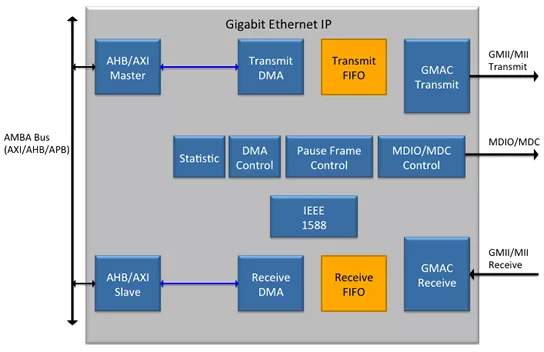
The Gigabit Ethernet Media Access Controller IP is compliant with the Ethernet IEEE 802.3-2008 standard and supports protocol extensions for Audio Video Bridging (AVB). The Gigabit Ethernet IP provides a 10/100 Mbps Media Independent Interface (MII) and a 1000 Mbps Gigabit Media Independent Interface (GMII). It also supports optional Reduced MII (RGMII), and Serial GMII (SGMII). The Gigabit Ethernet IP also implements Hardware-assisted 1588 Protocol for Time stamping the Receive and Transmit PTP Packets.
The Gigabit Ethernet with IEEE 1538 MAC IP is designed for SoC and mobile applications such as integrated networking devices, PCI-Express Ethernet controllers, and Ethernet adapter cards. The Gigabit Ethernet IP supports half-duplex mode at 10/100 Mbps and full-duplex mode at 10/100/1000 Mbps. The Gigabit Ethernet IP core consists of two configurable FIFOs on both transmit and receive sides to handle the application’s latency during frame transmission and reception. A processor bus master and a 32-bit scatter-gather DMA transfer packets between the internal FIFOs and the host memory to enhance system performance.
The Gigabit Ethernet with IEEE1538 MAC IP supports 4-bit MII based 10/100 Mbps PHY and 8-bit GMII based 10/100/1000 Mbps PHY. An MDIO/MDC (Management Data Input/Output and Management Data Clock) management interface provides control and management functions to external PHY devices. The Gigabit Ethernet IP also provides enhanced programmable features for minimizing application complexity and pre/post message processing.
The Gigabit Ethernet IP supports MIB, SNMP, RMON, VLAN Q-Tag frame, and Jumbo frames. It also includes dynamic generation, checking, and stripping of FCS field, automatic pad field insertion, automatic retransmission and detection of collision frames, collision avoidance and handling. Other features of the Gigabit Ethernet IEEE1538 MAC IP include generation and decoding of PAUSE control frames, frame boundary delimitation, frame synchronization, and error detection.
Note: some files may require an NDA depending on provider policy.

Gigabit Ethernet with IEEE 1588 and AVB is a Ethernet IP core from Arasan Chip Systems Inc. listed on Semi IP Hub.
Engineers should review the overview, key features, supported foundries and nodes, maturity, deliverables, and provider information before shortlisting this Ethernet IP.
Yes. Buyers can compare this product with similar semiconductor IP cores or IP families based on category, provider, process options, and structured technical specifications.