Arasan 16-bit xSPI/PSRAM Controller and PHY: Enabling High-Performance Embedded Memory Systems

As modern embedded systems continue to evolve toward AI-driven processing, advanced graphics, automotive intelligence, and high-speed edge computing, the demand for faster and more efficient external memory interfaces is rapidly increasing. Traditional SPI-based memory solutions are often unable to provide the bandwidth and low latency required by next-generation SoCs.
To address these growing performance requirements, 16-bit xSPI/PSRAM Controller and PHY solutions are emerging as critical building blocks for high-bandwidth embedded memory architectures.
By combining a high-speed xSPI controller with an optimized PHY layer, designers can achieve significantly improved throughput, lower latency, and reliable high-frequency operation for advanced embedded applications.
Explore Arasan IP:
Understanding Arasan 16-bit xSPI/PSRAM Architecture
A complete 16-bit xSPI/PSRAM subsystem typically consists of two major components:
- xSPI/PSRAM Controller
- xSPI/PSRAM PHY (Physical Layer)
Together, these components manage protocol handling, data transfers, timing alignment, calibration, and high-speed signaling between the SoC and external PSRAM devices.
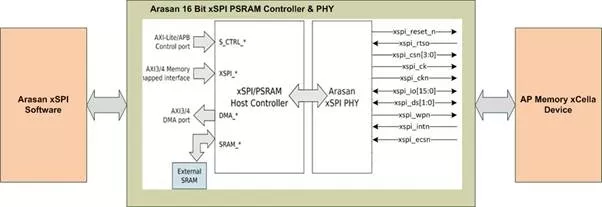
Figure 1: Arasan 16 Bit xSPI PSRAM Controller and PHY
What is a 16-bit xSPI/PSRAM Controller?
The xSPI/PSRAM Controller is responsible for managing all protocol-level operations between the processor and external memory.
Its key functions include:
- Command generation
- Address handling
- Read/write transaction management
- Burst transfer support
- SDR and DDR operation
- Execute-in-Place (XiP) functionality
- DMA coordination
- Error handling and status monitoring
The controller serves as the intelligent communication engine that enables efficient memory access and optimized data flow.
What is a 16-bit xSPI/PSRAM PHY?
The PHY (Physical Layer) is responsible for handling the high-speed electrical interface between the controller and external memory devices.
As interface speeds increase, PHY design becomes critical for maintaining reliable signal integrity and timing accuracy.
Key Functions of the PHY
The PHY performs several timing-critical operations, including:
- High-speed data serialization/deserialization
- Clock generation and distribution
- Read/write timing calibration
- Delay adjustment
- Signal alignment
- DDR timing optimization
- Data capture synchronization
Without a robust PHY, high-speed xSPI communication can suffer from signal integrity issues and timing failures.
Why PHY Design Matters in 16-bit xSPI Systems
As memory bandwidth increases, timing margins become smaller and system complexity increases.
A high-performance PHY enables:
- Reliable operation at higher frequencies
- Lower bit error rates
- Better signal integrity
- Improved timing margins
- Stable DDR operation
- Reduced PCB timing sensitivity
This becomes increasingly important in automotive, AI, and industrial systems where reliability is critical.
Benefits of Integrating Controller and PHY Solutions
A fully integrated 16-bit xSPI/PSRAM Controller and PHY solution provides several advantages:
- Simplified SoC integration
- Reduced design complexity
- Faster time-to-market
- Improved interoperability
- Easier timing closure
- Lower verification effort
- Optimized performance tuning
This enables semiconductor companies to accelerate product development while minimizing design risk.
The 16-bit architecture is increasingly becoming the preferred solution for high-performance embedded systems.
Conclusion
As embedded systems continue demanding higher bandwidth, lower latency, and greater scalability, memory subsystem architecture plays a central role in SoC performance. Arasan 16-bit xSPI/PSRAM Controller and PHY solution provides the high-speed communication foundation required for next-generation AI, automotive, industrial, multimedia, and networking applications.
By combining advanced protocol management with robust high-speed PHY technology, designers can achieve reliable, scalable, and future-ready external memory performance.
For semiconductor companies building advanced embedded platforms, adopting a 16-bit xSPI/PSRAM Controller and PHY architecture is becoming a key step toward enabling next-generation system performance.
Related Semiconductor IP
- xSPI - PSRAM Master
- 16-Bit xSPI PSRAM PHY
- Host controller IP for controlling flash and other devices on the SPI bus: Quad SPI, Octal SPI, and xSPI
- xSPI/SPI Verification IP
- xSPI Master IP | NOR IP
Related Blogs
- Cadence support for the Open NAND Flash Interface (ONFI) 3.0 controller and PHY IP solution + PCIe Controller IP opening the door for NVM Express support
- Cadence First to Demo Complete M-PCIe PHY and Controller Solution at MIPI and PCI-SIG Conferences
- Unlocking the Power of NAND ONFI Controller IP
- Exploring the XSPI PHY: Technical Characteristics, Architectural Challenges, and Arasan Chip Systems' Solution
Latest Blogs
- Tape-Out Readiness Checklist: Engineering Decisions That Prevent Costly Respins
- How Cadence DSPs Put In-Cabin AI Audio On-Chip in SemiDrive's X10
- The Fastest Path to Scalable Photonic Systems: Using Proven IP for both PIC and EIC designs
- Building Trusted AI Agents from the Silicon Root of Trust
- Heterogeneous Computing in Space