Vendor: CAST Category: Protocol Bridge

AXI to APB Bus Bridge

The AXI2APB implements a bridge between AXI and APB buses, allowing the connection of peripherals with an APB interface to an AXI…

Overview

The AXI2APB implements a bridge between AXI and APB buses, allowing the connection of peripherals with an APB interface to an AXI bus.

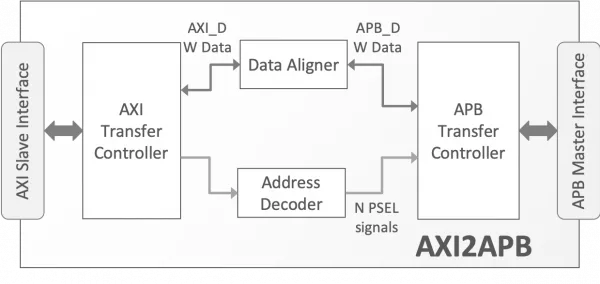
The highly configurable core translates read or write transactions on the AXI bus to APB bus transactions. An AXI4 master, such a microprocessor, can connect to its AXI slave interface, and APB4, APB3, or APB2 peripherals can connect to its APB master port. Furthermore, the endianness and the data bus widths of the AXI and APB interfaces are independently configurable.

The user can also select the number of APB slaves and their address mapping at synthesis time. To ease core configuration, the core’s deliverables include a software application that enables users to configure the core via an intuitive HTML interface and automatically generate the corresponding Verilog parameter values.

The LINT-clean and scan-ready AXI2APB core is extensively verified and proven in multiple production designs. It can be mapped to any ASIC or FPGA, provided sufficient silicon resources are available, and it is delivered with everything required for successful implementation including a testbench and comprehensive documentation.
Key features

  • AMBA™ AXI to APB Bridge
    • Allows connecting APB slaves to an AXI master
    • Supports AXI4 host and APB4, APB3, or APB2 Slaves
  • Configuration Parameters
    • AXI data bus width and endianness
    • APB data-bus width (can be different than AXI data-bus width)
    • APB address-bus width 
    • Number of APB Slaves
    • Data width, base address, and address space per APB Slave
    • Use of write strobe (PSTRB) and error response (PSLVERR) signal per slave 
  • Easy to Use and Integrate 
    • Requires no run-time programming or initialization 
    • HTML configuration tool generates Verilog parameters 
    • Fully synchronous, scan-ready, LINT-clean design
    • Delivered with sample scripts, RTL testbench, and sample test cases

Block Diagram

Specifications

Identity

Part Number
AXI2APB
Vendor
CAST
Type
Silicon IP

Files

Note: some files may require an NDA depending on provider policy.

Provider

HQ: USA

Learn more about Protocol Bridge IP core

Moving to AMBA® 5? Your AMBA® 4 IP Can Still Come With You

As SoC architectures adopt AMBA® 5 fabrics and components, many proven IP blocks still rely on AMBA® 4 or earlier interfaces. That creates a common integration problem: how do designers connect newer AMBA® 5 system components to existing IP without redesigning the IP or replacing verified blocks?

8051s in Modern Systems: Interfacing to AMBA Buses

Despite being 40 years old, 8051 microcontrollers can still serve useful roles in modern systems. But integrating 8051s in today's systems with their de facto standard AMBA® buses, wider datapaths, and shared memories can seem impossible. Yet it can be done. Here we take a look at the challenges, and how to overcome them.

A comparison of Network-on-Chip and Busses

This whitepaper summarizes the limitations of traditional bus-based approaches, introduces the advantages of the generic concept of NoC, and provides specific data about Arteris’ NoC, the first commercial implementation of such architectures

Frequently asked questions about Protocol Bridge IP cores

What is AXI to APB Bus Bridge?

AXI to APB Bus Bridge is a Protocol Bridge IP core from CAST listed on Semi IP Hub.

How should engineers evaluate this Protocol Bridge?

Engineers should review the overview, key features, supported foundries and nodes, maturity, deliverables, and provider information before shortlisting this Protocol Bridge IP.

Can this semiconductor IP be compared with similar products?

Yes. Buyers can compare this product with similar semiconductor IP cores or IP families based on category, provider, process options, and structured technical specifications.

×
Semiconductor IP