VSpector: Specification-Driven Bug Detection for RISC-V CPUs
By Tianyu Jia, Zhaoyang Yu, Yuanliang Chen, Wei You, Jianjun Huang, Bin Liang
Renmin University of China, Beijing, China
Abstract
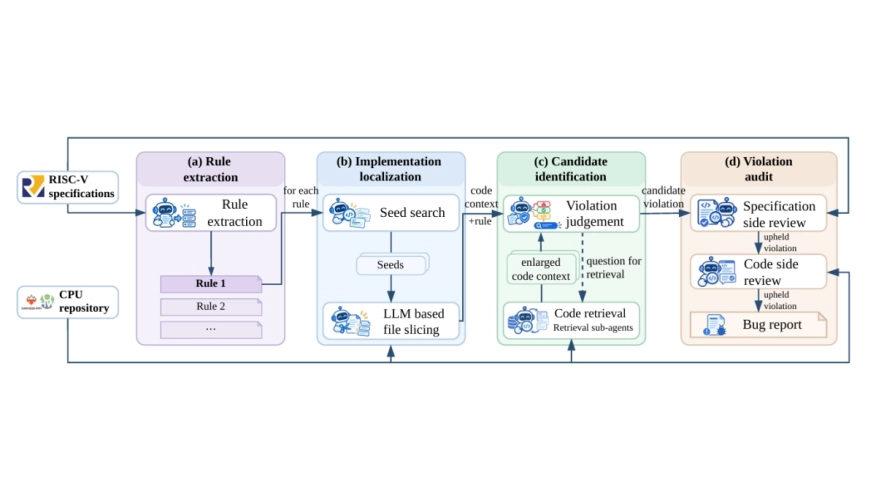
Detecting RTL design bugs in open-source RISC-V CPU implementations is critical for ensuring system reliability. Traditional detection approaches inherently rely on predefined artifacts. In this paper, we leverage the official, natural-language RISC-V specifications as an effective information source for bug detection. We present VSpector, a specification-driven bug detection pipeline that directly checks whether CPU register-transfer level (RTL) implementations adhere to official specification rules, without requiring specialized construction of reference models, formal properties, or custom bug patterns. To resolve the key technical trade-off between broad context scope and model reasoning accuracy when using Large Language Models (LLMs), VSpector employs a stepwise context refinement scheme across a four-stage pipeline: rule extraction, implementation localization, candidate identification, and sequential violation auditing. We evaluate VSpector on two industrial-strength RISC-V CPUs, CVA6 and XiangShan. Out of 217 reported candidates, manual inspection confirmed 148 true violations, representing a 68.2% precision. These violations correspond to 73 distinct bugs, including 42 previously unknown bugs. In our comparative experiments, DiveFuzz, a state-of-the-art CPU fuzzer, detected none of these new bugs during 24-hour runs per CPU. All 42 new bugs have been reported upstream, with developers already fixing 19 and confirming an additional 11 (30 in total), demonstrating that specification-driven auditing is a practical and complementary strategy for CPU bug detection.
To read the full article, click here
Related Semiconductor IP
- RISC-V Debug & Trace IP
- RISC-V IOPMP IP
- Gen#2 of 64-bit RISC-V core with out-of-order pipeline based complex
- 64-bit RISC-V core with in-order single issue pipeline. Tiny Linux-capable processor for IoT applications.
- Multi-core capable RISC-V processor with vector extensions
Related Articles
- LLM Inference with Codebook-based Q4X Quantization using the Llama.cpp Framework on RISC-V Vector CPUs
- DRsam: Detection of Fault-Based Microarchitectural Side-Channel Attacks in RISC-V Using Statistical Preprocessing and Association Rule Mining
- MultiVic: A Time-Predictable RISC-V Multi-Core Processor Optimized for Neural Network Inference
- FPGA-Accelerated RISC-V ISA Extensions for Efficient Neural Network Inference on Edge Devices
Latest Articles
- Anechoic: Onsager-Corrected Parallel Annealing for Sub-0.1 ms Dense Max-Cut on an FPGA
- Power, Performance, and Area of HPC-Based Malware Detectors: An FPGA and Open-PDK ASIC Study
- Terracotta: Enabling the Adoption of New DRAM Techniques via a Flexible DRAM Interface and Memory Controller
- A Framework for Accelerating Transformer Inference on RISC-V for Edge AI
- An Interleaved Parallel Dependent Quantization Hardware Architecture for H.266/VVC